



GPS/GNSS Products
Discover cutting-edge solutions from 18 leading global suppliers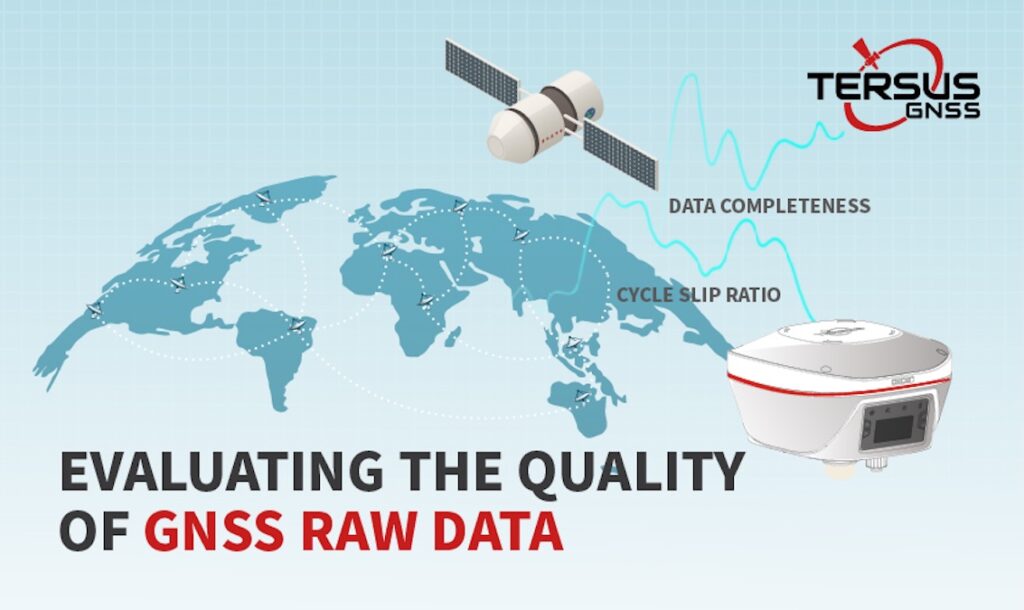
Tersus discusses the data completeness rate and cyclic slip ratio in quality evaluations for CORS base stations and mobile GNSS devices, highlighting how these calculations enable reliable monitoring and help identify environmental and device performance issues.
As satellite navigation technology evolves, so does the demand for high-precision GNSS positioning solutions.
The quality of raw GNSS data, specifically observation and ephemeris data, is crucial to product performance and data processing strategies. The quality of observation data also impacts the reliability of positioning, navigation, and timing (PNT) services.
Data Completeness Rate
GNSS data completeness measures the ratio of valid GNSS observational data received compared to the theoretical number expected during a given period. It encompasses the aspects of temporal, spatial, and signal integrity.
At each epoch, a GNSS receiver logs satellite data, such as pseudorange, carrier phase, Doppler shift, and signal-to-noise ratio (SNR), and the ephemeris data to calculate satellite positions. Disrupted data by interference or blockage is considered “lost,” lowering the completeness rate.
Raw data files are analyzed in RINEX format, using tools such as TEQC, RTKLIB, or custom python scripts. Actual and expected epoch timestamps are compared to determine missing epochs. Epochs with a SNR below a defined threshold are invalid, with carrier phase checks identifying abnormal epochs and cycle slips.
The GNSS systems’ sensitivity to data interruptions are also assessed under dynamic conditions, including signal blockage, multipath interference, low battery, and high temperatures.
Completeness judgements are made. ≥98% has little data loss, and ideal high-precision applications. 95–98%, with a slow slip frequency, is reliable for real-time solutions, whilst 90–95% has a moderate slip rate, affecting kinematic results. <90% has frequent cycle slips, with environmental and setup checks needed.
Regarding the key metrics, epoch loss rate is the percentage of missed or invalid epochs. Data gap duration refers to the length of each data interruption, with longer gaps impacting RTK initialization and PPP solutions. Multi-GNSS Redundancy assesses data completeness across multiple systems like GPS, BDS, and Galileo.
Many factors affect completeness rates, including physical obstructions, multipath effects, and atmospheric interference. Device-related issues may occur, like antenna performance or signal processing capability, with GNSS system factors, such as satellite geometry, frequency use, and sampling rate, also impacting results.
Cycle Slip Ratio
The cycle slip ratio quantifies the frequency of sudden changes in the number of carrier-phase cycles observed, comparing detected slips to expected observation epochs. These sudden jumps in the carrier phase are caused by signal loss, interference, or frequency switching.
There is a diverse range of detection methods, such as polynomial fitting, Melbourne-Wübbena combination, TurboEdit algorithm, and time-series smoothing techniques. TEQC, RTKLIB, GAMP, Anubis, and custom Python-based software are regularly used to analyse slip ratios.
In terms of key metrics, there are O/slips (observations per slip) measuring average number of observations between slips. Cycle slip distribution highlights consecutive slips are more disruptive than isolated ones. Multi-frequency comparison across bands like L1, L2, and L5, helps detect issues such as ionospheric disturbances or hardware faults.
For O/slips judgements, ≥1000 O/slips show stable data, and 500–1000 slips indicate low slip frequency, being reliable for real-time solutions. 200–500 demonstrates a moderate slip rate though, affecting kinematic results, and <200 has frequent slips which likely degrade performance.
Read the original article >>