
Aurora Flight Sciences, a subsidiary of Boeing, is advancing autonomous aircraft by translating long-standing research programs into operational flight systems.
Drawing on decades of experience in autonomy, advanced aircraft design, and flight testing, the company focuses on developing technologies that support safe, adaptable, and intelligent aircraft operations within shared airspace.
By combining advanced simulation tools, live flight testing, and AI-enabled software, Aurora examines how aircraft can learn, adapt to changing conditions, and operate predictably alongside human operators. This integrated development approach is intended to ensure autonomy is practical, testable, and suitable for real-world use.
Dr. Mia Stevens, chief engineer of the Accelerating Testing of Live Autonomy Software (ATLAS) program at Aurora, stated, “Aurora has been advancing autonomous flight for over 35 years. What sets us apart is how we bring together research, flight testing, and real aircraft to make autonomy operational. We’re building systems that will define how the next generation of aircraft think and fly.”
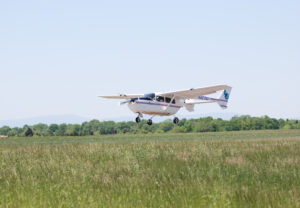
Chiron’s flight control software provided a measure of autonomy, giving onboard computers control of the autopilot system, navigation, propulsion, and the data link used to send and receive information to and from a ground control station.
Aurora explains that optionally piloted aircraft play a key role in bridging conventional piloted flight and full autonomy. This work began with the Chiron program in 1996 and continues today with Centaur, a next-generation optionally piloted aircraft used for repeatable autonomy testing in operational environments, with or without an onboard safety pilot.
Autonomy Across Platforms
The company applies its autonomy technologies across multiple platforms, drawing on expertise in Guidance, Navigation, and Control, perception systems, and early-stage research. Together, these capabilities allow aircraft to sense their environment, make informed decisions, and execute precise maneuvers. Perception software supports functions such as obstacle detection and landing area identification, while GNC architectures maintain stability and mission readiness from initial design through flight testing.
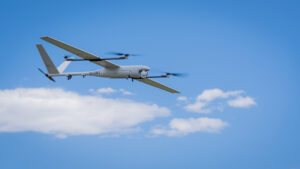
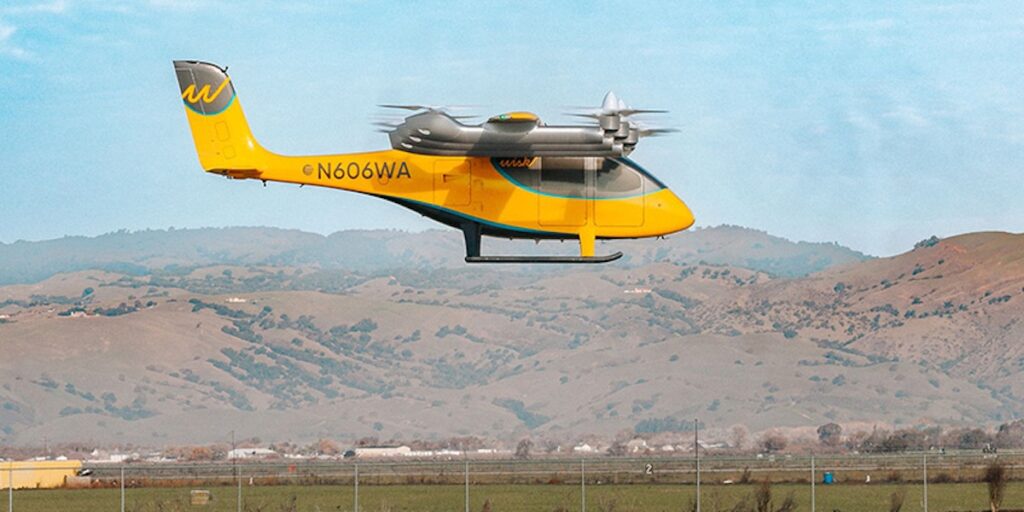
SKIRON-X is a Group 2 drone that combines the simple operation of an electric vertical take-off and landing configuration with the longer range and endurance of a fixed-wing design.
These include SKIRON-X, a Group 2 small uncrewed aircraft system used as a fast-moving test platform for autonomy software, perception systems, and decision-making algorithms, enabling rapid experimentation across varied missions and environments, as well as the Autonomous Aerial Cargo Utility System program, which demonstrated how a UH-1 helicopter could perform autonomous takeoff, flight, landing site selection, and payload delivery without direct human control.
A Human-Centric Approach
Aurora emphasizes a human-centric approach, in which autonomy is designed to complement human oversight. Autonomous systems are evaluated in simulation, hardware-in-the-loop environments, and live flight tests, pairing automated decision-making with human judgement to enhance safety, trust, and mission effectiveness.