Discover World-Leading Unmanned and Autonomous Technologies
Discover cutting-edge solutions from leading global suppliers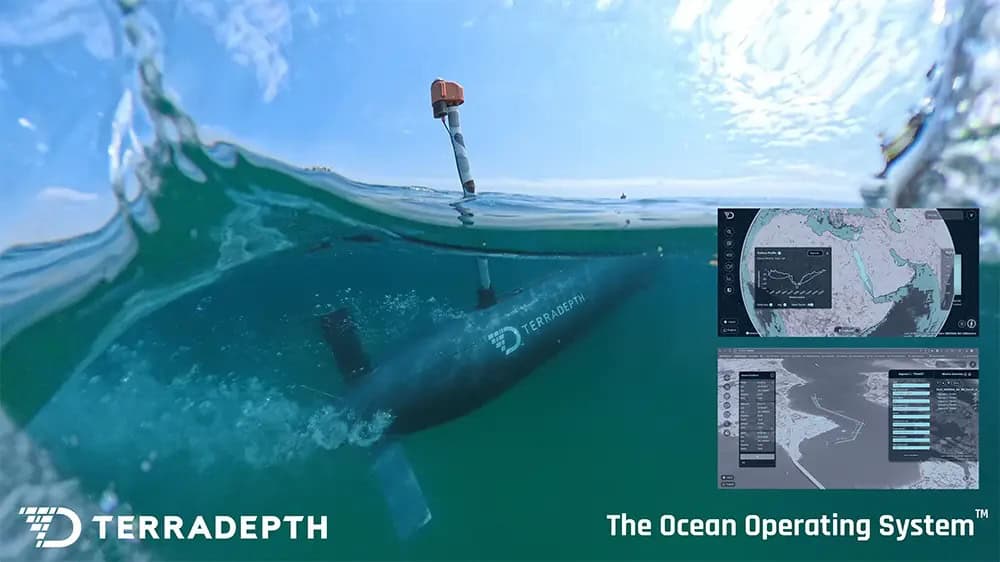
Terradepth has announced that its Absolute Ocean cloud-native data-to-decision software platform has been formally moved into the Rapid Capabilities Cell Hopper at the Naval Information Warfare Center Atlantic.
The selection follows a successful Phase II Pitch under the NIWC Atlantic Commercial Solutions Opening for the Unmanned Naval Innovation Team in Robotics and Autonomous Systems. This placement designates Absolute Ocean as a government-evaluated and immediately available prototype solution, enabling U.S. Navy sponsors to execute direct prototype Other Transaction agreements for up to 24 months. This mechanism is designed to accelerate and scale the deployment of undersea autonomy, data fusion, and decision advantage.
“This is a pivotal milestone in making Absolute Ocean accessible to government customers,” said Joe Wolfel, Founder and CEO at Terradepth. “RCC Hopper turns a rigorous competitive review into an off-the-shelf acquisition option that any USG customer can use immediately. Our technology is no longer ‘in process’—it is ready to buy, ready to field, and ready to deliver decisive maritime superiority at the speed of relevance.”
The platform serves as the software foundation of the Ocean Operating System, an integrated subsea data ecosystem spanning autonomous vehicle fleets, edge computing, and cloud federation. An integral component is AO OnBoard, an on-vessel computing capability that extends the platform to the edge. This allows for secure data access and visualization across both vessel and shore, facilitating raw data visualization directly from the vessel without the need for post-mission hard-drive transfers or full cloud uploads, even in low-bandwidth environments.
Operating across unclassified and classified environments, including NIPRNet, SIPRNet, and TS/SCI domains, the system utilizes computer vision and custom machine learning models for automated target recognition. The technology provides a dynamic 3D common operating picture and has already been utilized in major U.S. Navy exercises such as RIMPAC 2024, TRIDENT SPECTRE, and ONR TOEE.
“Customers and partners have long asked for a unified platform that turns undersea data into weapons-grade intelligence without years of integration risk,” Wolfel added. “RCC Hopper validates that Absolute Ocean meets the need and provides the fastest pathway for the Navy and broader DoD to adopt it now.”
Terradepth is a venture-backed maritime technology company headquartered in Austin, Texas, with operations in Panama City Beach, Florida. The firm focuses on turning fragmented subsea data into decision-ready insight for critical environments, serving defense and commercial sectors including offshore energy, telecommunications, and national security. Its dual-use platform encompasses the design and deployment of subsea drones, autonomous data collection, and secure cloud access.
The company will demonstrate these capabilities at the upcoming Sea Air Space 2026 exhibition in National Harbor, Maryland. Demonstrations will include the edge-to-cloud workflow, hybrid large uncrewed underwater vehicle operations, and near real-time data-to-decision capabilities designed for contested maritime domains.