Heavy Lift Drones
Discover cutting-edge solutions from 14 leading global suppliers
Parallel Flight Technologies has received a regulatory exemption from the Federal Aviation Administration (FAA) to begin commercial operations of its Firefly heavy-lift hybrid Unmanned Aircraft System (UAS) within the United States.
The authorization, granted under 49 U.S.C. §44807, allows the company to deploy its technology for domestic industrial applications, including heavy sensor integration, wildland fire management, and logistics missions which require extended endurance and high onboard power.
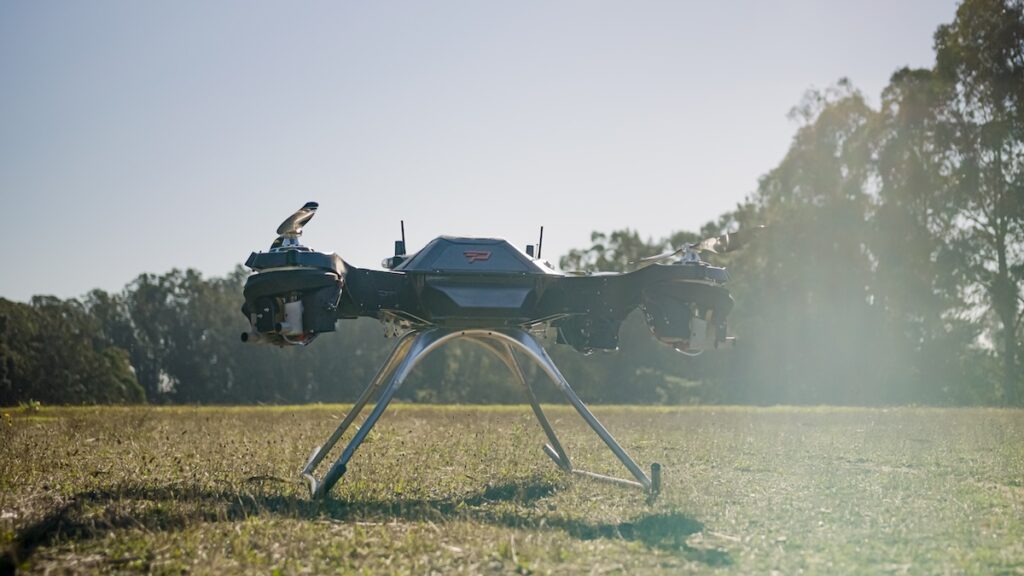
This milestone enables the transition of contracted programs and a qualified pipeline into active customer operations. The company, which has conducted years of rigorous reliability testing on its flagship Firefly platform, expects to begin shipping initial units to customers this summer.
Parallel’s Firefly is an NDAA-compliant Group 3 UAS manufactured in the United States, and regarded as a heavy-lift workhorse. Designed as a two-person-portable quadcopter that can be transported in a pickup truck, the platform is optimized for both expeditionary and industrial missions.
It utilizes a patented Parallel Hybrid Electric Multirotor (PHEM) propulsion system that provides up to 100 lb (45 kg) of payload capacity and endurance levels up to 10 times greater than standard all-electric systems. Additionally, the aircraft can provide 2 kW of continuous in-flight power to integrated payload systems.
Firefly has been supported by several federal agencies, including NASA, the USDA, the National Science Foundation (NSF), the Department of Defense’s Defense Innovation Unit (DIU), and the Office of Naval Research. The platform currently holds five patents protecting its unique hybrid architecture.
Craig Stevens, CEO of Parallel Flight, commented, “This is an important step for our team and our customers. The 44807 exemption validates the safety architecture, system design, and maturity of our platform. We are ready to support customers as demand for heavy-lift, long-endurance UAS continues to grow.”
As a provider of U.S.-manufactured, NDAA-compliant unmanned systems built for sustained commercial use, Parallel Flight intends to use this regulatory milestone to scale production and expand its approved flight envelopes to meet growing demand across global industrial markets.