Maritime AI Software
Discover cutting-edge solutions from leading global suppliers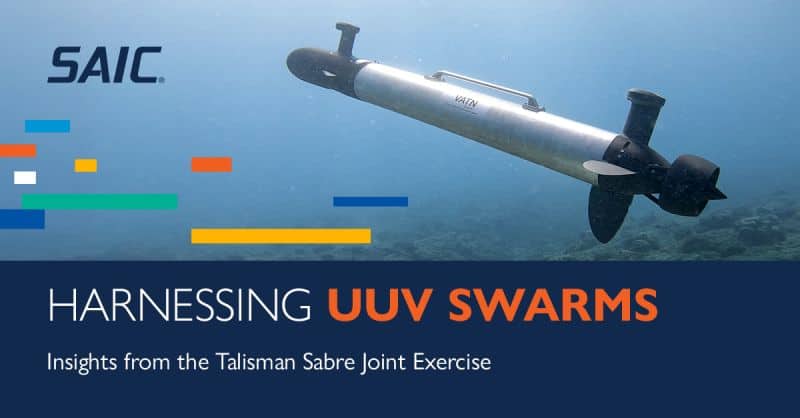
SAIC, a leading mission integrator, deployed next-generation capabilities for the Navy during Talisman Sabre 2025 (TS-25), a joint U.S., Australian, and allied military exercise.
The initiative explored how simulation, artificial intelligence (AI), and machine learning (ML) could be used to train swarms of Unmanned Underwater Vehicles (UUVs) to detect and track adversaries, allocate tasks, and operate autonomously with minimal reliance on centralized command. This capability is critical as adversaries increasingly use UUVs to disrupt maritime operations, requiring scalable, autonomous, and collaborative countermeasures, especially in communication-denied environments. The development aims to shift from expensive, time-consuming capability iterations to rapidly deployable undersea warfare systems.
For the exercise, a four-unit UUV swarm was deployed to patrol an area using sonar and acoustic communication systems. Each vehicle executed pre-trained algorithmic “plays” mimicking tactical maneuvers, enabling the swarm to respond quickly and cooperatively without external input.
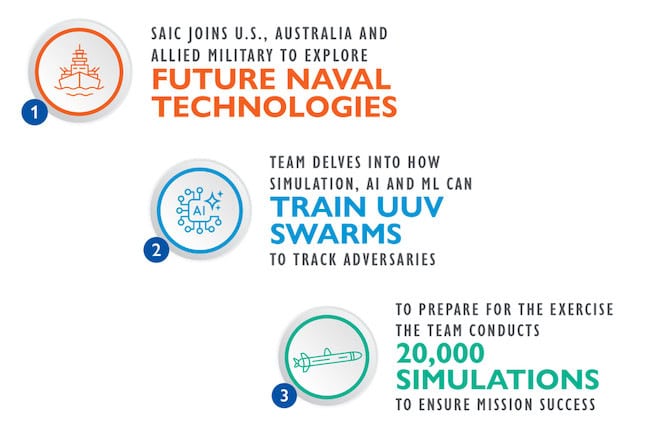
Before the physical deployment, over 20,000 high-fidelity simulations were conducted using a modified version of the Advanced Framework for Simulation Integration and Modeling (AFSIM) to test potential behaviors. The resulting training data informed a neural network capable of intelligently weighing tactical variables such as battery life, sonar range, and positioning to assign pursuit tasks, with validation accuracies exceeding 97%. The team also used digital twins and Robot Operating System-based surrogates with LiDAR to test AI logic on land, which cut development time by more than half while preserving mission logic and significantly reducing reliance on live testing.
In-water trials were conducted at depths of 1-10 meters, where the UUVs used Forward-Looking Sonar (FLS) and Doppler Velocity Logs (DVL) for navigation and detection. The vehicles successfully tracked adversaries and adjusted behaviors despite communication delays and environmental noise, with predictive modeling added to improve response reliability.
Each mission generated datasets tracking logs, sonar returns, and message sequences, all of which fed back into the simulation to form a continuous feedback loop. This process allows real-world performance to shape future training, making the system progressively smarter.
The swarm architecture supports low-bandwidth, delay-tolerant communication, modular AI integration, and the ability to add new behaviors or sensors quickly, which is designed for scalability and adaptability. This design helps create reliable, low-cost, and high-value missions. Future enhancements include heterogeneous teaming, where vehicles play distinct roles such as scouts or interceptors. Capabilities that once required months of coding and testing can now be accomplished in weeks, trained in simulation, validated on land, and deployed live. The result is a resilient, intelligent swarm system capable of executing missions in dynamic, noisy, and degraded environments.
This initiative marks a critical shift from static tools to adaptive, learning-enabled systems that are scalable, deployable, and mission-ready, offering both a technological edge and operational superiority in an era of rising undersea threats. The work involves collaborating with a diverse ecosystem of solution providers to enable the future of undersea warfare. The initiative will be presented at I/ITSEC 2025 as a model for rapidly fielding autonomous maritime capabilities.