Autonomous Control Systems
Discover cutting-edge solutions from 6 leading global suppliers
At the US Army’s Manoeuvre Support & Protection Integration Experiment 2025 (MSPIX 25), Robosys Automation, together with Vector Controls & Persistent Systems, showcased its Remote and Autonomous Control for Bridging and Rafting (RAC4BAR) solution.
RAC4BAR was demonstrated in response to an Army requirement to examine the capability to cross wet gaps.
Robosys adopted an open architecture approach for the demonstration, utilizing industry standards to retrofit an existing M30 Bridge Erection Boat (BEB) and enable remote command (RC) and autonomous operations of the vessel.
For the experiment, Vector Controls modified the vessel propulsion and steering controls to fly-by-wire CANBus controls, enabling digital control via an internet protocol (IP) network. A MILSTD computer was fitted to the vessel to host the Robosys VOYAGER artificial intelligence (AI) autopilot software, together with a mast mounted PS MPU5 radio to provide network connectivity.
Nigel Lee, Robosys’ Chief Strategy Officer, commented that the RAC4BAR system was designed to show various levels of command, autonomy and monitoring from different ranges in order to avoid personnel being exposed to danger. He noted that the RAC4BAR architecture was aligned with the US Modular Open Systems Approach (MOSA).
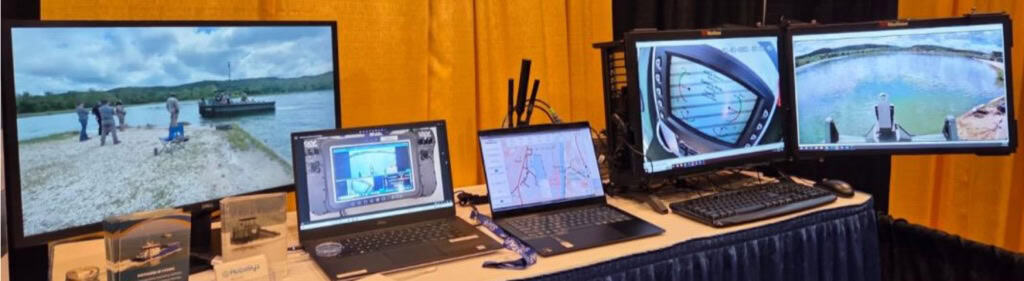
Two remote piloting IP cameras were installed for situational awareness for the remote operators plus a GPS receiver and compass for position and heading information. A local IP-based Mobile Adhoc NETwork (MANET) was established using MPU5 radios. This was connected via Starlink to a PS secure CloudRelay server. A second MANET was established 6km away which was also connected to CloudRelay via 5G, providing connectivity between the MANETs, and delivering a beyond-line-of-sight (BLOS) capability. The overall network provided data, video and voice communications.
Control of the vessel was exercised from different locations. A waist pack, connected directly to the vessel using 2.4GHz WiFi, was used at distances up to 500m for LOS operations. A tablet, connected to a MANET radio, provided non-LOS remote command. These provided local control for vessel berthing and unberthing.
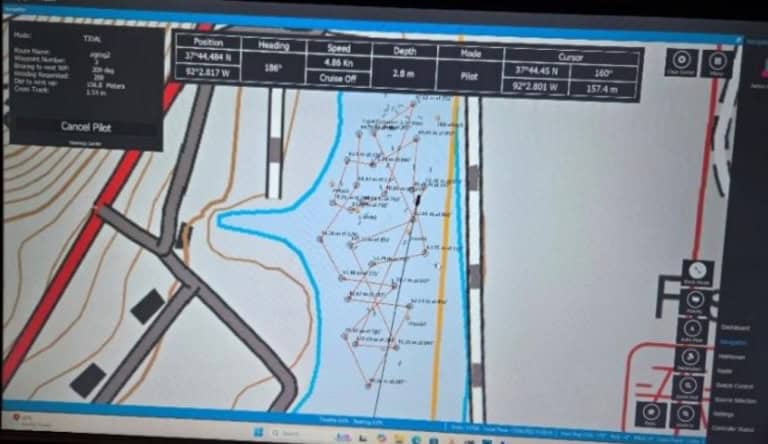
Ground control stations (GCS), hosting the VOYAGER software, were established locally and at 6km range to provide BLOS functionality. This allowed route and waypoint planning to be conducted from the GCS, enabling autonomous navigation.
Lee reported that by Day 4 of the experiment personnel “were conducting 25-point autonomous navigation routes within the challenging confines of the lake.” At the same stage an Improved Ribbon Bridge (IRB) module was attached to the BEB and the system adjusted to suit the turning characteristics of the combined IRB-BEB assembly.