




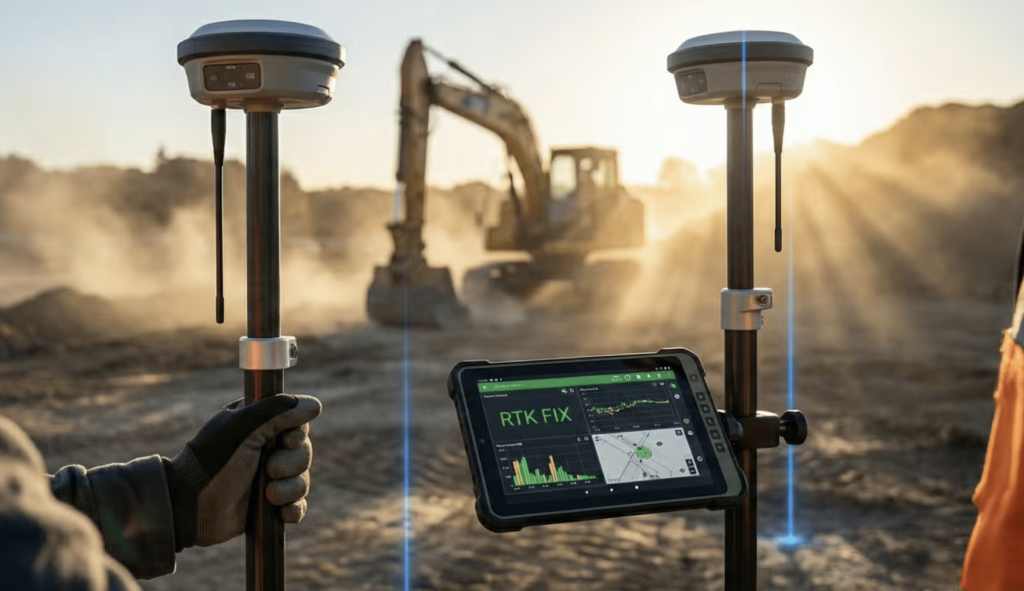
RTKdata highlights that Real-Time Kinematic (RTK) GPS delivers centimeter-level positional accuracy (1–2 cm) by applying live, ground-based corrections, making it indispensable for surveying, drone mapping, precision agriculture, and autonomous systems.
By contrast, standard GPS, or Single Point Positioning (SPP), offers 3–10 meter accuracy, sufficient for general navigation but inadequate for high-precision applications.
RTK achieves this through carrier-phase measurements and ambiguity resolution, typically requiring a nearby base station or network corrections delivered via protocols like RTCM and NTRIP. Status indicators like FIX vs FLOAT reveal solution confidence: FIX ensures highest precision, while FLOAT can introduce centimeter- to decimeter-level bias. Environmental factors such as multipath, obstructions, baseline length, and antenna setup also influence performance.
Workflow choice is crucial: RTK or Network RTK (NRTK) provides real-time cm-level positioning when communications are stable; PPK allows post-processed corrections for situations with intermittent links; PPP enables global access without a local base, though with convergence time; and DGPS/SBAS improves meter-level accuracy cost-effectively.
For operators spanning multiple sites, RTKdata offers access to 20,000+ reference stations in 140+ countries, streamlining correction delivery and ensuring reliable FIX solutions. Ultimately, RTK is a precision enhancement over standard GPS—but understanding its requirements, limitations, and correction workflows is key to achieving accurate, repeatable results in real-world operations.