ISR Drones
Discover cutting-edge solutions from 23 leading global suppliers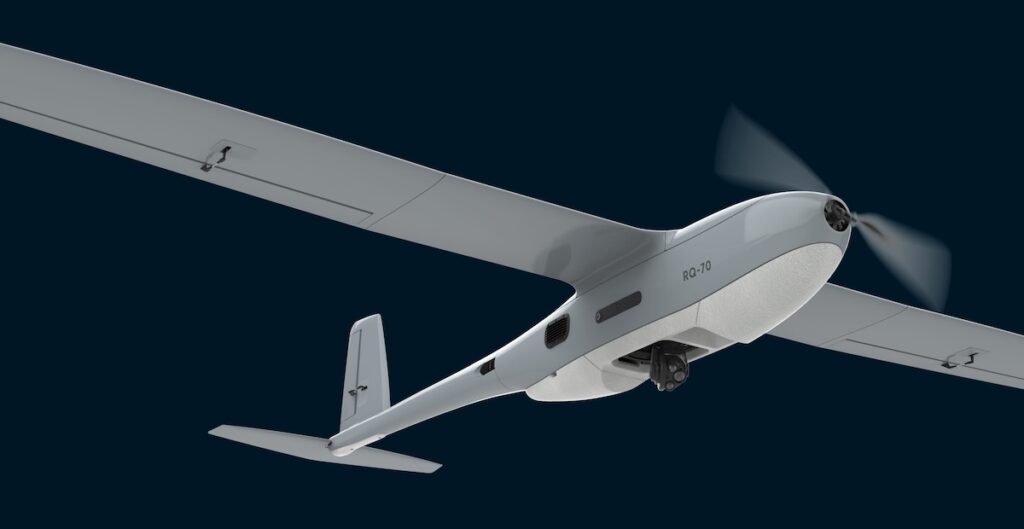
Danish unmanned systems developer Sky-Watch has introduced the RQ-70 Dainn, a new long-range unmanned aircraft system designed for target acquisition and intelligence, surveillance and reconnaissance missions.
The platform is being showcased at Eurosatory in Paris from June 15-19, 2026, highlighting a shift toward systems that can keep pace with the speed and complexity of modern warfare. Traditional defence models often remain too slow, operating on long cycles and heavy platforms removed from active decision-making. The RQ-70 Dainn aims to bridge this critical gap by translating real-world experience into immediate operational capability.
Development of the new system builds directly upon the RQ-35 Heidrun UAV platform, which has undergone four years of continuous real-world deployment and refinement in Ukraine. This field experience has been integrated into a system designed to extend range, endurance, and mission flexibility while maintaining operational speed, simplicity, and reliability.
“RQ-70 Dainn is not built on assumptions. It’s built on the backbone of the battlefield-proven RQ-35 Heidrun UAV platform shaped by continuous feedback loops,” says Martin Schousboe, CEO of Sky-Watch. “The problem today isn’t access to technology. It’s whether the technology works when it matters most, and whether it improves fast enough to keep up with modern warfare.”
Engineered for persistent capability in contested environments, the system features up to eight hours of endurance and an operational range extending beyond 62 miles (100 km) past frontlines. It supports vertical take-off and landing (VTOL) and utilizes a modular multi-mission payload architecture. The platform can be deployed by a single operator, remains resilient in GPS-denied environments, and connects directly to digital battlefields to deliver data under pressure.
Rather than focusing solely on the hardware, the platform is built to serve as an integrated component within a broader digital architecture.
“The RQ-70 Dainn is designed as an integrated system, where aircraft, sensors, software, interface and feedback loops work together, continuously improving based on real-world use,” says Schousboe. “The effectiveness lies in being part of a larger, connected digital architecture with software connecting sensors to decision-makers to effectors, all in near real time. In the context of modern warfare, it’s no longer just about what the UAV sees. It’s about how quickly the information travels, and how smartly it’s interpreted.”
This integration provides operators with clearer intelligence, faster decisions, and reduced guesswork in high-stakes environments.
“What matters is not the platform. It’s what it enables,” says Schousboe. “How quickly you can turn data into decisions, and how fast you can improve capabilities based on real use, because when the cost of being wrong is high, better decisions are what bring people home.”
The development process was driven by direct feedback from frontline operators in Ukraine, establishing a continuous loop between field use and system improvement. This methodology aligns with a broader industry shift away from slow procurement cycles and standalone platforms toward continuous learning, integrated capabilities, and operational proof. Sky-Watch positions itself as part of a new generation of defence companies focused on delivering capability that holds up under pressure and improves as conditions change.
Operational demonstrations for the system will be available starting in July 2026, with bookings open at Eurosatory. Full-scale production is projected to begin in January 2027, with initial deliveries planned to scale in subsequent years based on market demand and program execution.