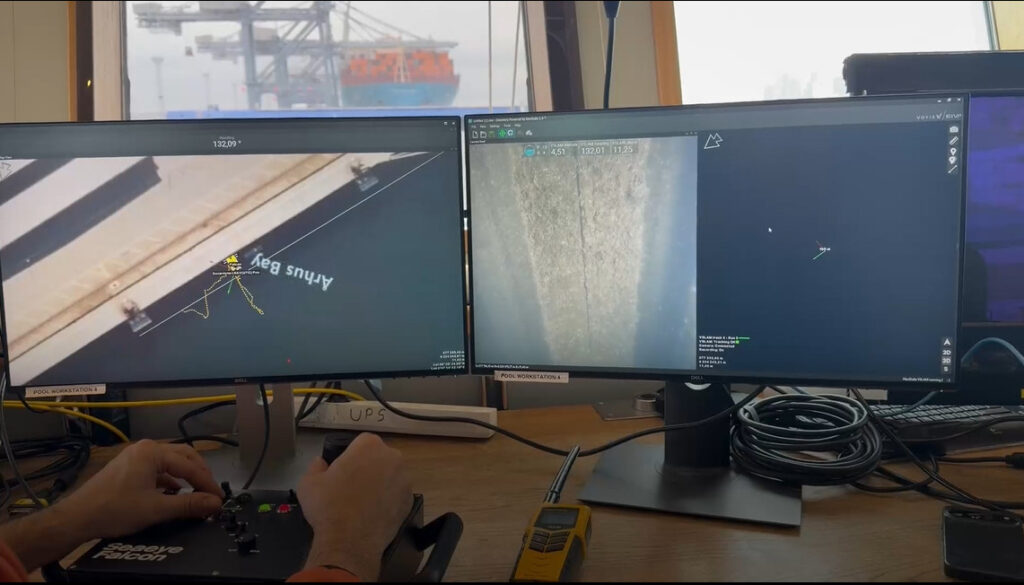
Voyis and EIVA have announced a significant technical advancement to their collaborative VSLAM solution that introduces absolute geo-located mapping to real-time camera-based 3D reconstruction.
This update allows VSLAM-generated point clouds to be projected directly into global coordinates from the moment a subsea inspection mission begins. By bridging the gap between camera-based navigation and established industry survey standards, the system ensures that visual mapping is natively aligned to global geodetic frames.
The integration leverages EIVA’s NaviSuite geodesy computational tools, which have been a staple of professional subsea survey workflows for over 40 years. By embedding this geodetic engine, users can define specific settings and select coordinate systems from the full EPSG Library prior to data acquisition. This ensures that every 3D point generated by the solution is immediately tied to a known global reference frame, providing the consistency and reliability required for offshore operations.
At the start of a mission, the software reads the initial global position from a connected Inertial Navigation System, such as a Sonardyne SPRINT-Nav, to place the map into the selected geodetic frame. This alignment remains stable throughout the dive, even during relocalisation or loop closure events. While the VSLAM engine continues to refine local map geometry, the global placement is preserved.
This capability transforms how pilots and surveyors interact with 3D reconstructions. Situational awareness is improved through the ability to load background maps, reference charts, or seabed models directly beneath the live point cloud. Furthermore, a priori models, including CAD drawings of subsea structures, can be overlaid for immediate comparison. Targets can be marked in absolute coordinates and revisited across different dives or vessels, while ROV navigation becomes more intuitive, facilitating safer maneuvering and more efficient tether management.
The update focuses on operational efficiency and repeatability. Operators can now achieve cross-dive continuity by resuming inspections exactly where they ended, with the map already aligned to the global frame. This simplifies the correlation between inspection data, engineering drawings, and historic survey datasets. By aligning to known structures, the system reduces redundant coverage and streamlines mission planning.
Once the data is collected, the generated point clouds can be managed through NaviModel. This allows users to re-project datasets into alternative reference frames as project requirements evolve, ensuring long-term compatibility with engineering standards.
As part of the Covelya Group, Voyis and EIVA intend for this update to strengthen the delivery of survey-aligned perception systems. By unifying real-time visual mapping with trusted geodetic frameworks, the companies are establishing a foundation for more autonomous, high-confidence underwater operations across the defense, marine science, and offshore energy sectors.