eVTOL Drones
Discover cutting-edge solutions from 13 leading global suppliers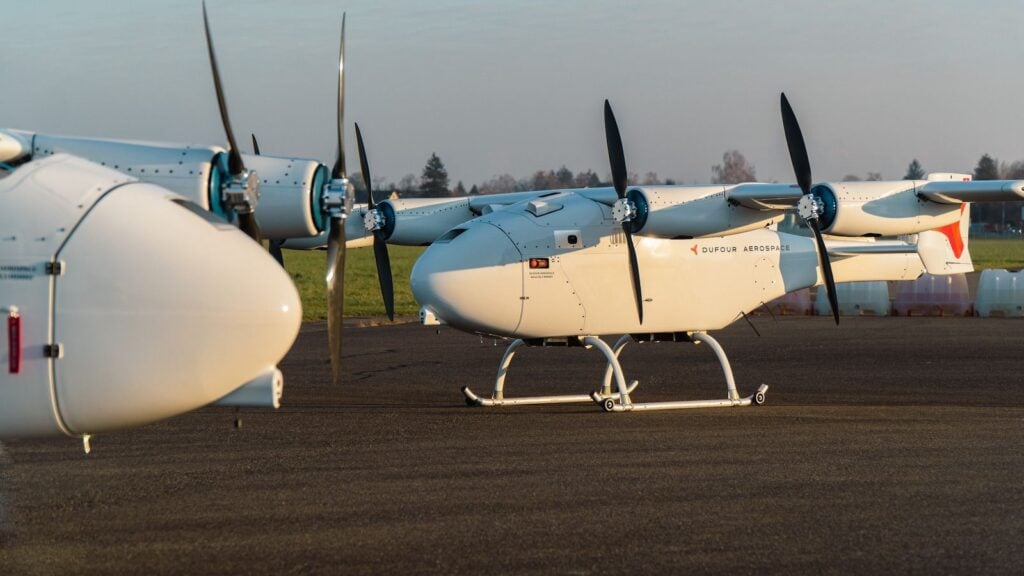
Dufour Aerospace has completed its first flight test campaign with a hybrid-electric engine specifically designed for its Aero2 drone, successfully conducting several trial flights in Zurich.
The Aero2 completed multiple flights with the hybrid system, self-charging its batteries in flight and successfully transitioning from vertical takeoff to forward flight.
This milestone aligns with Dufour’s vision of a hybrid-electric powertrain, with an innovative tilt-wing design and autonomous capabilities. This is reportedly the first-ever successful flight of a large-scale serial hybrid-electric aircraft transitioning from vertical takeoff to forward flight.
Aero2 relies entirely on high-performance batteries for takeoff. As it transitions to forward flight, its hybrid-electric system activates to generate electricity, recharging the batteries and powering the motors.
Currently, the hybrid system operates on conventional gasoline but is being adapted for heavier fuels such as sustainable aviation fuel and kerosene. Its carbon footprint and operating costs are considerably lower than those of helicopters or conventional fuel-powered helicopter-type drones currently in use.
Sascha Hardegger, CEO of Dufour Aerospace, commented, “Dufour Aerospace achieved a major milestone with these flights. All of Dufour’s in-house developments — the Flight Control System and Control Software, Power Management System, and the integrated Powertrain — must work together seamlessly to achieve this.
“The beauty of the Aero2 is mission efficiency and a simpler system for charging aircraft. Our customers do not need to plug in the Aero2 for hours to run their next mission. Recharging is accomplished in the air, not on the ground, enabling back-to-back missions. It can land, exchange the payload, and restart the next mission immediately.”
Hardegger also stated, “Dufour has proven the critical systems on the aircraft. It demonstrates that our aircraft will be mission-ready for all the use cases we envision. Initially, we are focusing on the delivery of critical cargo such as medical goods or urgently needed spare parts, where we are seeing a lot of operators and end-users waiting for efficient transport solutions. Additionally, we are closely looking into supporting various remote-sensing applications.”