Discover World-Leading Unmanned and Autonomous Technologies
Discover cutting-edge solutions from leading global suppliers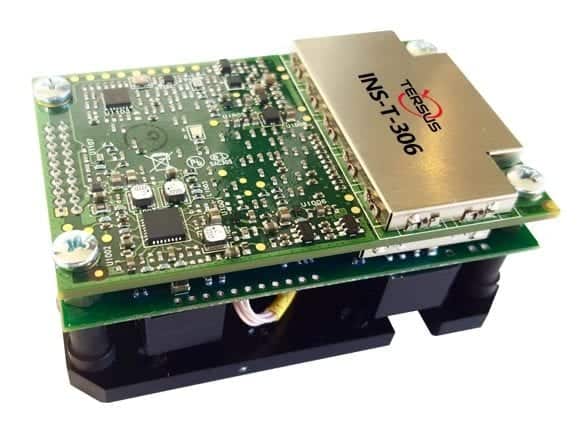
Tersus GNSS, a developer of Global Navigation Satellite System (GNSS) technologies, has announced its new INS-T-306 GNSS-Aided Inertial Navigation System (INS). The module combines GPS L1/L2, GLONASS and BDS navigation in a high-performance strapdown system. It is capable of determining position, velocity and absolute orientation (heading, pitch and roll) for any device on which it is mounted.
The launch of this INS unit aims to facilitate both motionless and dynamic applications which require high accuracy, such as navigation for marine vessels, helicopters and other aircraft, as well as unmanned aerial vehicles (UAVs) and unmanned ground vehicles (UGVs).
The INS-T-306 combines on-board sensor fusion filtering, guidance algorithms and calibration software andutilizes an advanced GNSS receiver, barometer, magnetometers, MEMS accelerometers and gyroscopes to provide accurate position, velocity, heading, pitch and roll of the device under measure. It supports GPS L1/L2, GLONASS, BDS, DGPS, and RTK, and can also be integrated into LiDAR systems (Velodyne, RIEGL, and FARO).