Below, Numurus founder and CEO Jason Seawall explores how edge AI is reaching a “Windows moment” for robotics, arguing that accessible software platforms like NEPI are making advanced AI-powered automation easier to deploy by removing the complexity traditionally associated with embedded systems and robotic development.
Before Windows, only engineers and computer scientists could do much with computers. Windows changed that by giving everyone a user interface, built-in apps, and plug-and-play hardware capabilities that all worked together. The same shift is now arriving for robots.

Jason Seawall
By Jason Seawall, Founder and CEO, Numurus
I remember when the first PCs came out. I was just starting college to become a robotics engineer, and I was excited. PC’s were powerful machines. Microprocessors were faster than anything most people had touched, and the capabilities they offered for solving mathematical problems and running complex engineering processes in minutes was exciting.
But at the time, the usefulness of PC’s was limited to a small group of engineers and computer scientists who had the skills and interest to learn how to use them. To make a PC do something, you had to know how to work with command-line only operating system interfaces, learn complex hardware protocols, and write software from scratch. Like most of my friends and family at the time, the world looked at a PC and saw an expensive box that did not do much for them. That all changed when Windows hit the market and turned PC’s from a niche engineering tool into a device usable by anyone in the world.
Today, there is a new and rapidly growing market of edge AI processors, embedded processors that run AI models in robotic and other automated systems from companies like NVIDIA, AMD, Qualcomm, Hailo and others. These chips allow systems to rapidly analyze camera and other data and make split-second control decisions without needing to be connected to the internet. They are fast enough, cheap, and power-efficient enough to run real AI workloads in the field.
The hardware is past the inflection point. But the people who can actually use these processors are still a small group. While they typically come with a Linux operating system that has built-in applications, hardware support, and user interfaces similar to Windows and other desktop PC operating systems, the solution does little to support the needs of customers wanting to use these chips.
First off, robots need to interface with cameras, lasers, GPS, motors, and control systems, not mice, keyboards and printers. Robots need software applications that can connect live sensor data to AI models to control motors, not word processing and spreadsheet applications. Finally, Robots don’t typically have keyboards and displays connected to them for user interfacing, they need user interfaces that connect through web-browsers on network connected PC’s.
These limitations mean once again, only a small group of experienced engineers and software developers are able to take advantage of the capabilities that these new edge AI processors make possible. For everyone else, an edge AI processor is the same kind of expensive box the PC was in 1981. Capable, but inaccessible.
As a robotics and automation engineer, I quickly saw the potential these chips offered for solving many of the the challenges the industry had been struggling with for many years. After using some of these edge AI processors on robotic and smart sensing projects, I also realized how difficult and time consuming it was to use these chips, even for teams of experienced engineers and developers, so in 2020 my company Numurus pivoted from selling robotic smart sensors to developing an easy to use software platform called NEPI (Numurus Edge Platform Interface) that takes care of much of the under-the-hood software most robotic and automation solutions require.
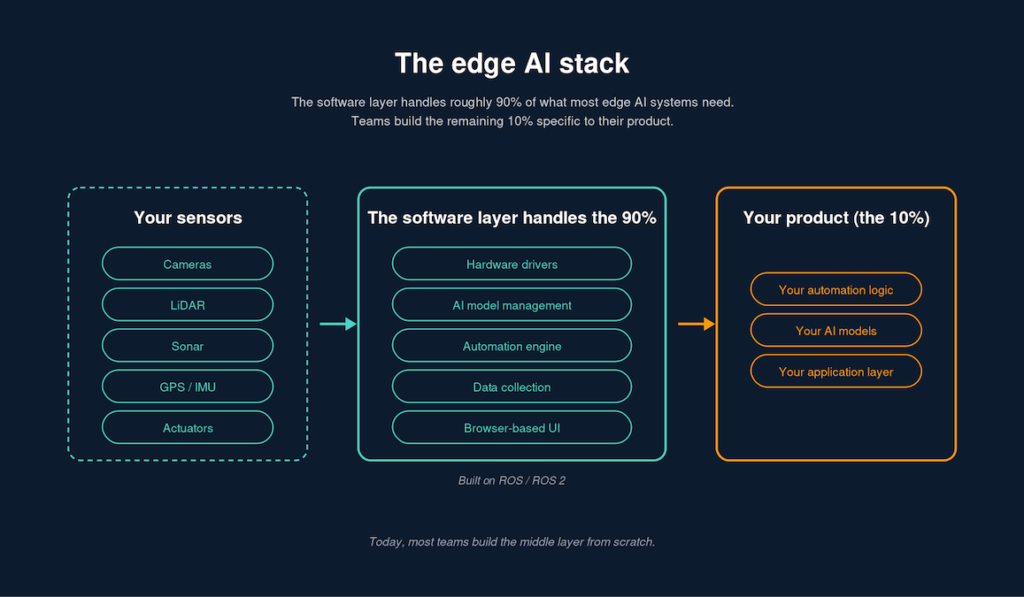
NEPI provides plug-and-play drivers for cameras, navigation sensors, motors, lights, and control systems, auto detection and orchestration of AI models, built-in automation applications, and an intuitive browser-based user interface for connecting from remote network connected PC’s. NEPI installs and runs as a Docker container on top of the edge AI chip’s naive operating system, allowing anyone to download and get working in minutes with no computer programming experience needed. NEPI also includes a simple pull, deploy, and build system for downloading and customizing the source-code from our NEPI Github repository.
What Windows Did for the PC
What unlocked the PC was not faster hardware. It was a software layer that handled the things most people did not want to learn how to do. Windows arrived with plug-and-play drivers. Connect a printer and the system found it and made it work. Connect a mouse, same thing. The user did not have to write a single line of code to interact with hardware they had not chosen in advance.
Windows came with built-in applications. A word processor, a spreadsheet, a way to look at files. Most users did not need to write applications. They needed applications to exist. Windows gave the PC a screen, a keyboard, and a mouse all working together through a UI that did not require a manual. Most users figured it out in an afternoon.
After Windows, the PC was no longer just for specialists. It was for everyone. The hardware did not change. The access did.
What Edge AI Processors Need to Become Useful to More People
Edge AI is waiting for the same shift. The hardware is here. What is missing is a software layer that handles the things most people do not want to learn how to do.
That layer needs plug-and-play hardware drivers. If a team wants to add a camera, a sonar, a lidar, an IMU, or a GPS module, they should be able to connect it and have the system recognize it. They should not have to write a driver for it.
It needs AI model management. Loading a model, versioning it, swapping it for a newer one, recovering when something fails. Most teams have a model. Few teams want to build the runtime that surrounds it. It needs built-in applications for the actual use cases. Robotics. Automation. Inspection. Sensor data processing. Event-driven action. The most common needs in this space should be solved out of the box, not rebuilt every project. And it needs a UI that the operator can actually use. This is where edge AI has a wrinkle the original PC did not have. Most edge AI systems are robots, drones, vessels, or industrial equipment. They do not have a keyboard, a mouse, or a screen attached. The UI has to come from somewhere else.
The answer is a browser-based interface served from the device itself. Connect a laptop, point a browser at the device, and you have a UI. No specialized hardware. No specialized software. Anyone with a browser can interact with the system.
Who Benefits When Edge AI Becomes Accessible
The story of the PC is also the story of who got to use a computer. Before Windows, computers were for programmers, researchers, and people willing to learn how to write code. After Windows, computers were for accountants, writers, students, kids, parents, and schools. The audience grew by orders of magnitude, and the applications that got built on top reflected the new audience.
Edge AI is about to go through the same expansion. Today, edge AI is mostly for teams that can afford embedded software experts. That usually means well-funded robotics startups, established OEMs, and defense contractors. Everyone else is locked out, not by hardware cost but by software complexity. Once edge AI becomes accessible, the audience changes. STEM programs can integrate AI-based automation without requiring every team member to be an embedded software expert.
Researchers in adjacent fields can prototype AI-enabled hardware without hiring a separate embedded team. Startups can ship the first version of their product in a few weeks instead of a year. OEMs can offer their customers AI capabilities the customers can actually configure themselves. This expansion is not just good for the people who get new access. It is good for the industry. The PC ecosystem did not get bigger because programmers got more productive. It got bigger because people who were not programmers got to use computers. Edge AI is set up to follow the same path.
Glimpses From the Field
The shift is already starting to show up in production. Teams building autonomous surface vessels for maritime threat detection have been able to focus on the vessel and the mission rather than on building their own edge AI stack. Commercial fishing operators using AI-enabled sonar have been able to focus on the fisheries expertise that makes their product different. Underwater inspection robot makers have added AI-driven inspection to their platforms without building model deployment pipelines and data capture systems from scratch.
Subsea infrastructure inspection teams have been able to focus on inspection methodology rather than embedded systems engineering. In each of these cases, the team did not have to become an embedded software shop in order to ship an AI-enabled product. The access was unlocked. As more platforms ship in this category over the next twelve to twenty-four months, more teams will get the same option.
For the Experts: The Build-From-Scratch Problem
Even for teams that do have embedded software experts, the math has changed. Most robotics teams building an AI-enabled product in the last decade have rebuilt some version of the same five layers from scratch. Sensor integration. AI deployment runtime. Automation logic. Data pipelines. Operator interfaces. None of these are what makes the product unique. They are the floor every product has to stand on. And until recently, most teams were laying their own floor.
The cost of this shows up in four places. Engineering time, typically six to twelve months before a team ships the first version of their actual product. Fragility, when custom integration code breaks every time hardware changes. Talent allocation, when senior engineers end up maintaining drivers instead of building differentiated features. And the hardest cost to measure, the products that never get built because the infrastructure investment was too daunting.
For teams that have the expertise, the platform layer is not the only way to build edge AI. But it is the way to ship faster, with less custom code to maintain, and with a foundation that does not have to be rebuilt the next time a new product idea comes up.
The Shift That Is Happening
The PC era was not won by faster hardware. It was won by the software layer that made faster hardware useful to people who were not specialists. Edge AI is heading into the same transition. The hardware is here. The software layer that makes it accessible is being built right now, by a small number of platform teams that have figured out what it needs to look like.
If you are working on something that involves AI at the edge, whether you are a robotics engineer, an OEM, a STEM educator, or a researcher, the question worth asking is not whether the hardware can do what you want. It almost certainly can. The question is whether you want to spend years developing everything from scratch, or jump in and start working on the automation solution you’re after in just a few days using NEPI. With automated installation scripts, anyone can download and try NEPI in minutes.
Check out the ‘Get Started’ page at www.nepi.com.
Jason Seawall is the founder and CEO of Numurus, an edge AI platform company based in Seattle. He previously founded BlueView Technologies, which was acquired by Teledyne, where he served as VP of Technology overseeing innovation across Teledyne’s marine technology group.