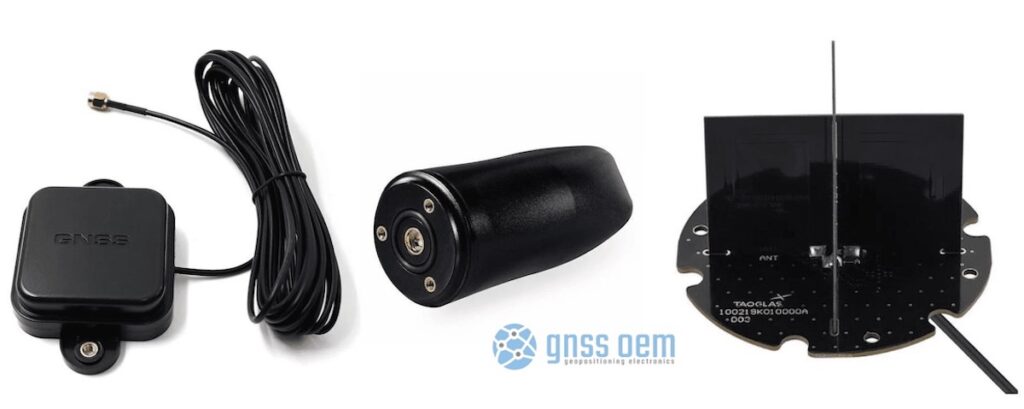
GNSS.Store, a developer and manufacturer of advanced Positioning, Navigation and Timing (PNT) solutions, provides a variety of antenna types for OEMs and system integrators in the drone and robotics industries.
The company highlights the distinct roles of patch, helix, and cross-dipole antennas in achieving accurate positioning performance.
Patch Antennas
Flat ceramic patch antennas operate best with a ground plane, making them suitable for vehicles or fixed installations rather than aerial or handheld platforms. They offer low Phase Center Variation (PCV), beneficial for Real Time Kinematic (RTK) applications. When mounted on a ground plane, signals reflected from below are effectively blocked, though tilting can expose the antenna to side reflections. Compared with helix designs of similar quality, patch antennas are heavier but more cost-efficient.
Helix Antennas
Helix antennas, typically featuring four spirals, are lightweight and suppress multipath signals without a ground plane. Their design makes them ideal for drones, wearable systems, and other moving platforms that frequently tilt. Before RTK use, ensuring a small phase center is recommended. At equivalent quality, helix antennas are lighter but more expensive than patch models.
Cross-Dipole Antennas
Cross-dipole antennas filter reflected signals more effectively than patch or helix types and maintain uniform reception across satellite elevations. While their phase center is generally larger than that of premium patch antennas, they remain suitable for drone RTK use. Certain variants capture low-horizon signals from as little as five degrees above the horizon. These antennas are costlier than patch or helix options but offer an optimal lightweight solution for high-precision applications.
GNSS.Store’s range of antenna types provides integrators and developers with reliable, high-performance options for modern autonomous and positioning systems.
Read the full article here.