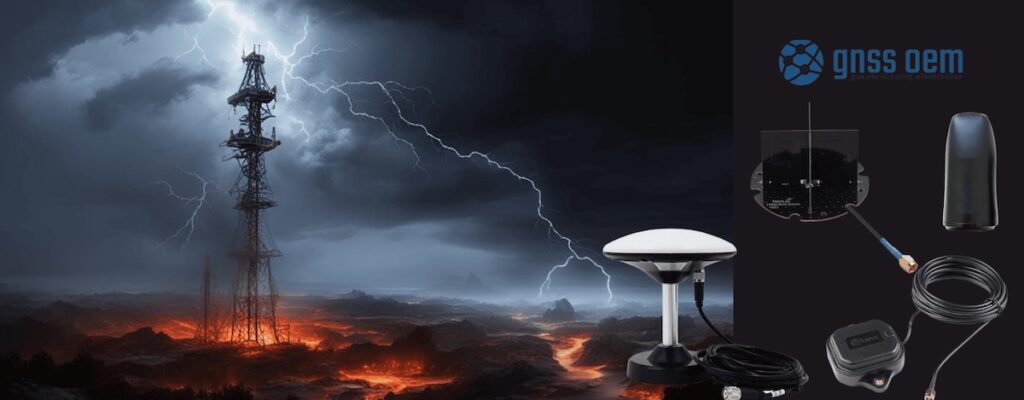
GNSS.store, a developer of high-performance PNT (Positioning, Navigation, and Timing) solutions for OEMs and systems integrators in the UAV industry, explains how antennas can be protected from lightning strikes and the challenges involved. Read more >>
In the context of lightning protection, the fundamental principle is to avoid becoming the most exposed or attractive target for a strike. No antenna can survive a direct lightning strike, regardless of its protection. The goal, therefore, is to help it withstand the indirect effects of lightning, the induced surges from distant strikes.
The best approach is to position the antenna so that lightning is more likely to strike a lightning rod installed farther away and higher up.
The main vulnerability of an antenna during distant lightning strikes lies in the coaxial cable that connects it to the receiver. Surges can travel along this cable, impacting both the antenna and receiver.
Protecting sensitive antenna inputs and high-frequency circuits is more complex than protecting low-frequency systems such as telephone lines, where varistors and spark gaps can be installed. These large protective elements can absorb substantial amounts of energy without interfering with signal transmission.
High-frequency systems such as those handling GNSS signals require precise management of protective component characteristics. Every picofarad of capacitance in a protective component can weaken signal quality.
To address this, engineers use low-capacitance TVS diodes or assemblies combining fast diodes with more robust TVS elements. These designs maintain low capacitance while still absorbing significant impulse energy.
Even with these solutions, the protection is limited. Antenna input circuits are granted certain allowances under standards for high-energy pulse resistance, acknowledging the balance between performance and protection.
Some antennas, particularly timing models, incorporate integrated lightning protection, but this is typically effective for only 5-6 events, serving as the final layer of defense. The first and main line of antenna protection is a distant and higher lightning rod.
To find out more information read ‘Lightning Protection That Doesn’t Exist’ here >>