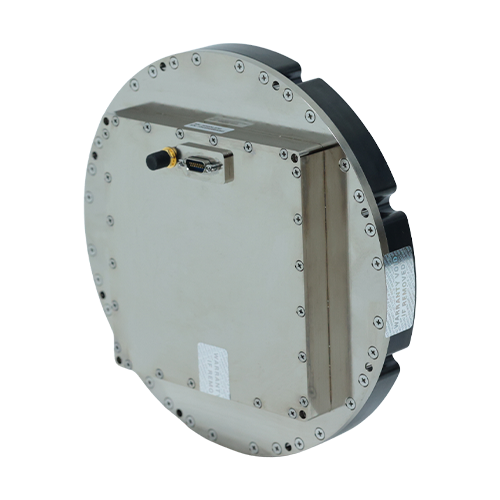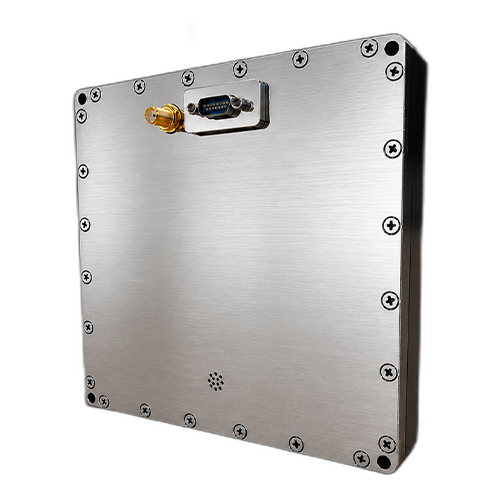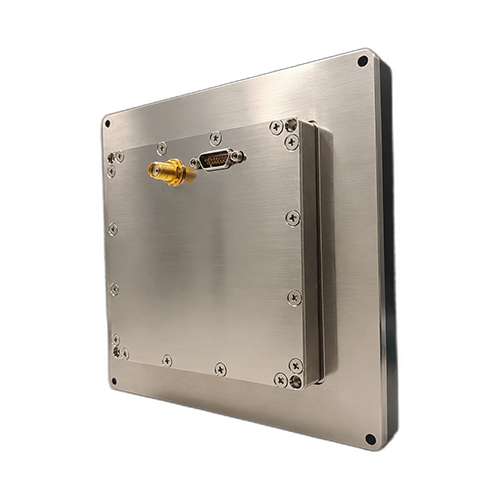
EDGE Microwave outlines a frequency tracking method for mitigating narrowband interference in GNSS receivers, addressing signals generated by Personal Privacy Devices (PPDs) that emit strong tones or swept narrowband interference to intentionally disrupt receiver lock.
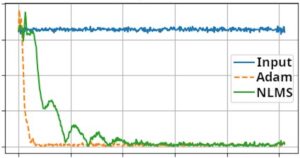
Excision techniques deployed in receivers remove interference in either the time domain or transform domain, but accurate placement of the excision point is essential to prevent degradation of the underlying GNSS signal. Frequency trackers are therefore assessed according to both dynamic tracking capability against rapidly sweeping jammers and steady-state estimation jitter, reflecting the trade-off between tracking speed and estimation variance.
The proposed approach introduces a new frequency tracking algorithm based on first and second moments of the gradient for a complex first-order IIR notch filter operating under an output power minimization objective. Inspired by the Adam optimization method widely used in neural network parameter optimization, the Adam-based Adaptive Notch Filter (Adam-ANF) is presented in relation to existing Adaptive Notch Filter (ANF) update rules. The method is designed to improve the balance between rapid convergence and reduced estimation variance when compared with conventional techniques.
Performance is analyzed across a wide range of simulated and recorded interference events, including publicly available datasets, with benchmarking conducted against state-of-the-art approaches such as Frequency-Locked-Loop (FLL)-based designs. Resource utilization, latency, and the effects of quantization and pipeline delays are also examined for both the proposed method and representative baseline implementations. Results indicate that the Adam-based approach requires only marginally higher resource usage than a conventional adaptive notch filter while delivering improved suppression performance across most evaluated scenarios.
Adam-ANF achieves higher suppression against fast chirp interference than conventional NLMS-based ANF designs due to faster convergence characteristics. The hyperparameter tuning space is also wider than that of NLMS-ANF, providing greater robustness under changing operating conditions. The method additionally supports the broader class of Adaptive Neural Filters (ANeF), enabling potential higher-dimensional parameterizations of conventional ANF architectures.
Explore the adaptive frequency tracking approach for mitigating narrowband interference in GNSS receivers on the EDGE Microwave website.