




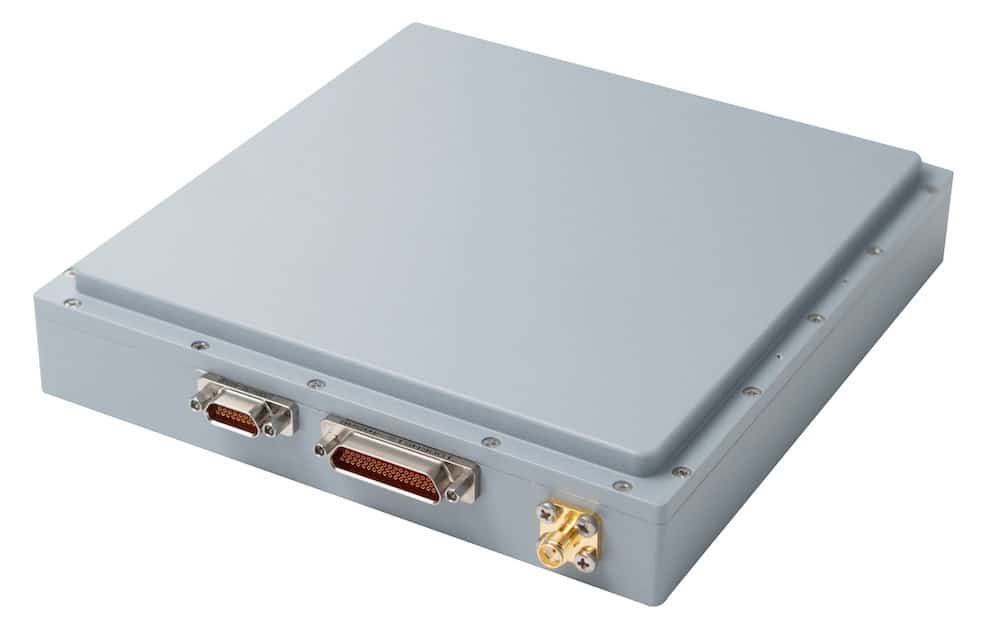
The Compact IFM Receiver from TUALCOM captures radar signals across the 2 to 18 GHz spectrum and generates Pulse Description Words (PDWs) in real time, including frequency, amplitude, pulse width, time of arrival, and PRI for transmission over a Gigabit Ethernet interface. An LVDS interface is provided for critical settings and telemetry. The ultra compact design integrates DFD and SDLVA blocks with a signal processor that produces more than two million PDWs per second. User defined digital filters help remove undesired signals, and switch multiplexer filters can be added for further rejection.
The system is available in single or dual channel configurations and can be stacked for multi channel direction finding capability. Projects can also leverage superheterodyne receiver variants for wider frequency coverage and DRFM based options for radar simulators, ECM, and COMINT applications. The receiver delivers low SWaP performance, a user friendly interface, and compliance with MIL STD 810G and MIL STD 461F.
Specifications:
| Dimensions (cm): | 15.2 × 14.7 × 3.0 |
| Weight (g): | 1060 |
| Frequency Band: | 2 to 18 GHz |
| Instantaneous Bandwidth: | 16 GHz |
| Frequency Sensitivity: | 1 MHz |
| Frequency Precision: | ≤ 3 MHz RMS |
| Dynamic Range: | 65 dB (-55, +10 dB) |
| Minimum Pulse Width: | 100 ns |
| Maximum Pulse Width: | CW |
| PW Precision: | 10 ns |
| Amplitude Precision: | 3 dB RMS |
| Operating Power: | 400 mA @ 28 V DC |
| RF Connector: | SMA Female |
| Data Connector: | Micro-D 15 Pin Female, Micro-D 51 Pin Female |
| Operating Temperature (°C): | -40 to +80 |
| Environmental Condition: | MIL STD 810G |
| EMI / EMC: | MIL STD 461F |





