




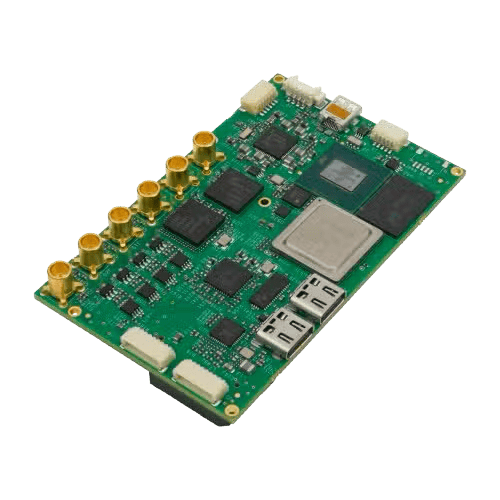
Jupiter Mini is a compact AI-enabled video processing platform designed for tactical surveillance and intelligence-gathering operations across land, air, and naval environments. The low-power unit captures, processes, records, and streams high-quality video and audio with ultra-low latency, combining H.264/H.265 encoding and decoding, transcoding, display, raw-data pre-processing, and edge AI capabilities on a single compact board.
Built for embedded and mission-critical systems, Jupiter Mini supports smooth multi-stream HD video processing and onboard analytics for real-time detection and recognition tasks. With dual Gigabit Ethernet connectivity, support for both HD-SDI and composite camera inputs, and onboard eMMC and microSD storage, the platform delivers reliable performance for tactical ISR, border protection, search and rescue, and situational awareness applications.
Specifications:
| Dimensions: | 80 × 50 mm board outline 2.2 mm maximum component height (B2B side) |
| Power: | ~7 W typical Input voltage: 3.3 V to 5.5 V |
| Memory: | 6 GB LPDDR4 |
| AI Accelerator: | Hailo-8 neural network processor |
| Video & Imaging: | H.264/H.265 multi-stream engine 1080p60 encode and 1080p60 decode 2 camera input ports: (a) 4 × composite and 1 × HD-SDI, or (b) 2 × HD-SDI |
| Storage: | 32 GB onboard eMMC microSD (SD 3.0/SDXC) slot |
| Interfaces: | 2 × 10/100/1000 Mb Ethernet 2 × USB 3.0 Type-C (1 × OTG, 1 × Host) PCIe Gen3 x1 2 × UART RS-422 GPIO |
| Compute: | Quad-core ARM Cortex-A53 up to 1.6 GHz |
| Operating Temperature: | –40 °C to +85 °C |





