




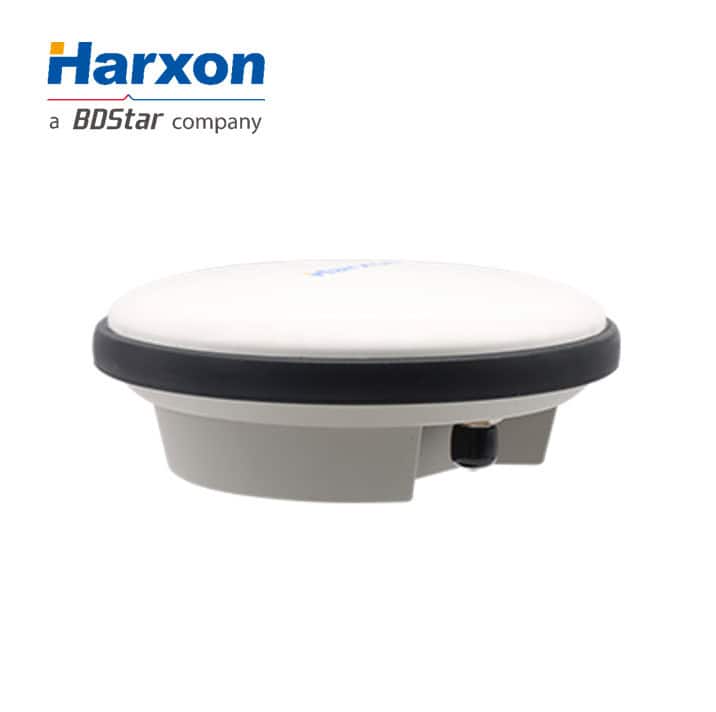
Harxon’s Ruggedized GNSS Antennas are engineered for high-precision positioning in tough environments like I-construction, marine applications, and Heavy-duty agricultural applications. Designed to withstand high shock and vibration, these antennas feature IP67 or IP69K-rated enclosures, ensuring durability against dust, rain, and extreme temperatures. With advanced multi-point feeding technology and stable phase center variation, they deliver stable phase center variation, millimeter-level accuracy, and robust signal tracking across all GNSS constellations and L-Band correction services.
Built with a robust metal base, Harxon’s Ruggedized Antennas ensure exceptional durability for long-term use in extreme conditions. They offer two versatile mounting options—magnetic mount for quick, secure attachment and pole mount for stable, permanent installation. The antennas feature flexible cable configurations with side-exit or bottom-exit options, accommodating diverse integration needs. In addition to standard models, there's also small size version HX-CVX603A
| Product | Protect Rating | Frequency | Peak Gain | Dimensions |
| HX-CVX606A | IP67, IP69K | GPS L1/L2/L5, GLONASS L1/L2/L3, GALILEO E1/E5a/E5b/E6, BDS B1/B2/B3, QZSS L1/L2/L5/L6, IRNSS L5, SBAS L1/L5, L-Band | 5.5dBi | Φ150*57.3mm |
| HX-CVX600A | IP67, IP69K | GPS L1/L2/L5, GLONASS L1/L2/L3, GALILEO E1/E5a/E5b/E6, BDS B1/B2/B3, QZSS L1/L2/L5/L6, IRNSS L5, SBAS L1/L5, L-Band | 5.5dBi | Φ150x53mm |
| HX-CVX603A | IP67 | GPS L1/L2/L5, GLONASS L1/L2/L3, GALILEO E1/E5a/E5b/E6, BDS B1/B2/B3, QZSS L1/L2/L3/L6, IRNSS L5, SBAS L1/L5, L-Band | 4dBi | Φ90.6x26mm |





