Discover World-Leading Unmanned and Autonomous Technologies
Discover cutting-edge solutions from leading global suppliers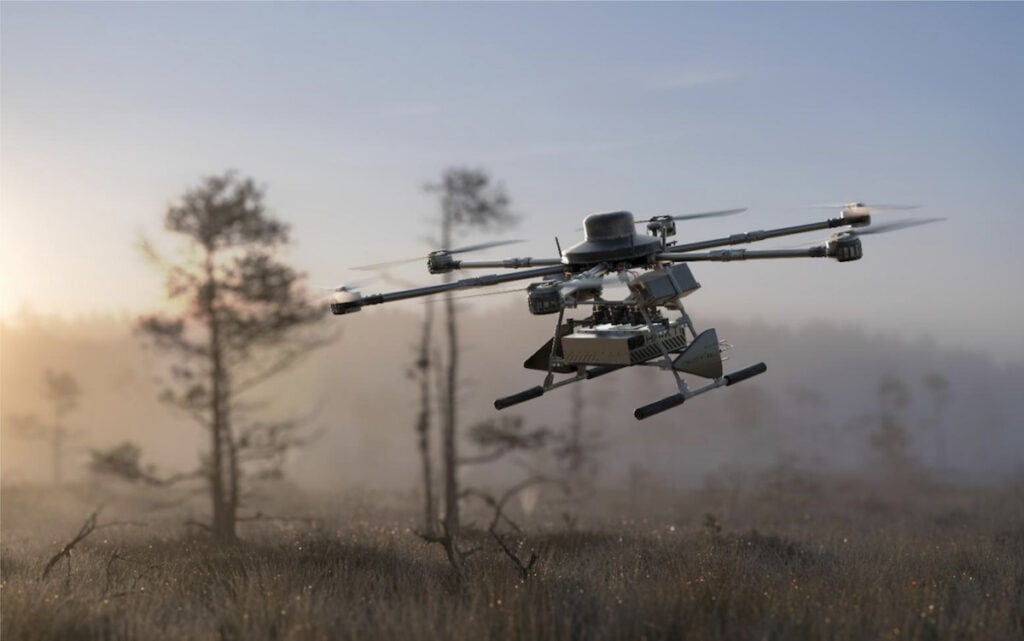
The new AARTOS Hawk T1, unveiled by Aaronia AG at Eurosatory 2026 in Paris, moves electronic drone detection capabilities into the sky by employing an airborne, passive radio frequency geolocation system that relays situational data in real time.
While conventional counter-drone operations utilize ground-based sensors that observe the skies from fixed vantage points, this new payload configuration introduces an aerial perspective. Weighing under five kilograms, the unit integrates directly onto commercial multi-rotor or fixed-wing platforms. This positioning allows operators to maintain tactical visibility and capture signals even when complex terrain obstructs the line of sight of ground installations.
The system is built on the SPECTRAN V6 real-time spectrum analyzer and uses Blind Time Difference of Arrival technology to geolocate threats. This allows the system to pinpoint signals from drone operators, first-person view links, LoRa ground stations, GPS spoofers, jammers, and radar. The technology tracks unknown, encrypted, or previously uncharacterized signals with a localized accuracy of up to 25 by 25 meters. An internal processing unit provides signal analysis within GPS-degraded or jammed environments, with timing synchronized via multi-band global navigation satellite systems. Oven-controlled crystal oscillator and coherent chip-scale atomic clock configurations are also available as reference options.
Covering standard civilian and military bands from 10 MHz to 8 GHz, with an optional expansion down to 9 kHz and up to 18 GHz, the device features a real-time bandwidth of 245 MHz and a sweep speed of 1,100 GHz per second. Field testing has demonstrated that a network of three payload units can geolocate LoRa-based drone stations at ranges up to 75 kilometers, while individual scenarios have achieved overall signal detection ranges exceeding 80 kilometers.
The software architecture is driven by the RTSA-Suite PRO analysis platform, enabling the system to interface seamlessly with existing counter-UAS networks. This ecosystem currently supports more than 700 permanent installations worldwide, protecting major international hubs including London Heathrow, Changi, and Muscat airports. The broader platform has also been deployed in mobile configurations to secure international events such as the G20 Summit in Rio de Janeiro and the NATO Summit in The Hague.
“Drones are getting smaller, faster, and tactically more sophisticated. Meeting that challenge requires systems that are just as adaptable as the threat itself,” says Stephan Kraschansky, Chief Defense & Government Solutions Officer at Aaronia AG. “With the Hawk T1, we are pulling the AARTOS common operating picture out of the air for the first time – creating a new quality of situational awareness that no ground-based system can come close to matching.”