VTOL UAV
Discover cutting-edge solutions from 34 leading global suppliers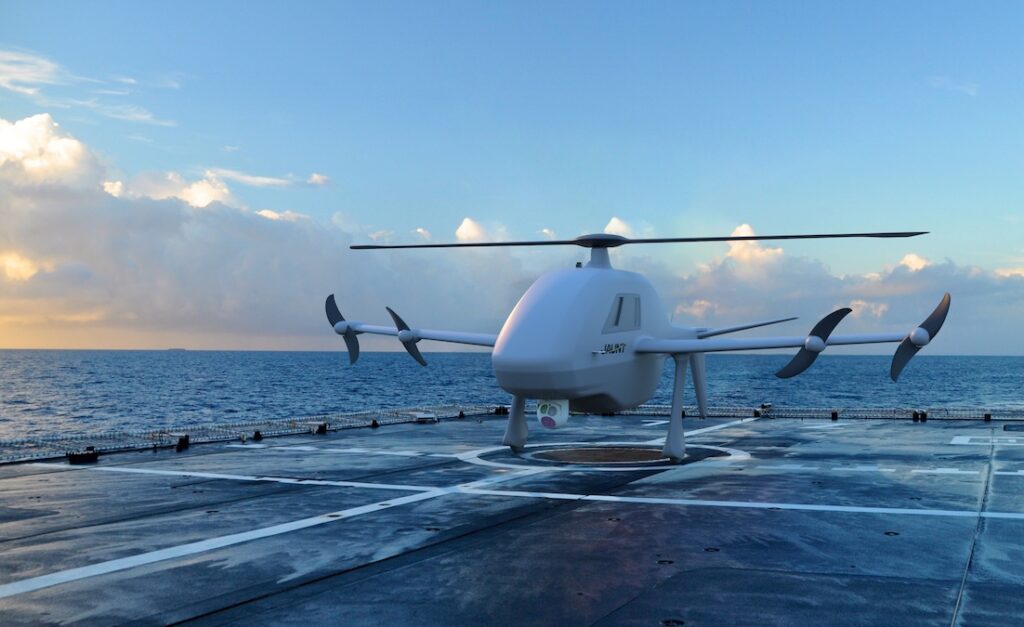
AIRO Group Holdings and its brand Jaunt Air Mobility have unveiled their full-scale autonomous Vertical Take-Off and Landing (VTOL) aircraft at AUVSI XPONENTIAL 2026, designed for defense, government, and dual-use cargo operations.
The platform represents a significant milestone in the development of heavy-lift, hybrid-electric aviation. The aircraft is engineered to operate in austere and infrastructure-limited environments where traditional aviation solutions are often unavailable. By utilizing a slowed rotor architecture that combines vertical lift with efficient forward flight, the system is designed to provide reliable, scalable capability across diverse mission sets.
The program is currently in the detailed design and engineering phase, with development tracking ahead of internal expectations and below projected research and development cost targets. AIRO, a next-generation aerospace and defense company, is utilizing digital engineering and early system validation to accelerate the development timeline. Based on current progress, the company expects the first flight to take place by the end of this year, with commercialization and operational deployment targeted for 2027.
The platform features a common architecture optimized for two primary mission configurations. The JC250 is tailored for middle-mile logistics, remote resupply, and humanitarian operations, featuring a detachable cargo pod system for rapid loading and unloading. The JX250 is configured for Intelligence, Surveillance, and Reconnaissance (ISR) missions. Based on continued design optimization and mission analysis, the ISR configuration is projected to achieve more than 1,000 miles of range and up to 16 hours of endurance.
Joe Burns, AIRO CEO, commented, “This unveiling marks an important step as we move from concept to a tangible platform. The aircraft is designed to deliver reliable, scalable capability in environments where traditional aviation solutions are limited or unavailable.”
The hybrid-electric propulsion architecture is intended to support extended range and operational flexibility, while the modular design enables mission adaptability across both government and commercial applications.
Martin Peryea, AIRO SVP & GM Electric Air Mobility, stated, “We are advancing the aircraft through design and development, enabled by an accelerated approach that integrates digital engineering and early system validation. We remain on track for first flight by the end of this year.”
Dr. Simon Briceno, AIRO VP Business Strategy, added, “This unveiling highlights the aircraft’s core capabilities—from its slowed rotor architecture to its combination of vertical lift and efficient forward flight and the flexibility enabled through modular payload configurations. These are the elements that we expect to drive real value across both government and commercial applications.”