Discover World-Leading Unmanned and Autonomous Technologies
Discover cutting-edge solutions from leading global suppliers
U.S.-based developer Hall Lidar Inc has introduced a first-generation acoustic drone detection system designed to provide 3D situational awareness through passive sound signatures.
The UDL-64, also known as the Ultimate Drone Listener, addresses a growing gap in counter-UAS technology where traditional radar, radio frequency, and optical systems face limitations. Radar can be hindered by terrain and aerial clutter, while radio frequency-based solutions are increasingly ineffective against autonomous drones that do not emit signals. By relying on the physical sound signatures produced by drone rotors, the UDL-64 operates independently of GPS availability, visual conditions, or radio signals.
Because the system is passive and emits no signals, it remains undetectable to adversaries. The technology utilizes a high-density microphone array paired with edge-based AI processing to capture spatial sound data. Real-time beamforming techniques isolate and track aerial threats, while trained acoustic models classify drones by their rotor signatures, effectively filtering out environmental noise such as wind or urban traffic.
David Hall, CEO and Head Scientist, said, “Customers should not have to choose between performance and security. We’ve built a system that delivers both—advanced AI-based acoustic detection with the assurance of American manufacturing and supply chain integrity.”
The physical architecture of the UDL-64 is engineered for durability and performance in harsh environments. The 24-inch diameter sensor array is housed in a rugged, weather-resistant enclosure with no moving parts. It is designed for rapid deployment, capable of being set up on a tripod or mast in approximately one minute. This makes the platform suitable for both mobile response units and permanent installations at critical infrastructure sites such as airports, energy facilities, and transportation hubs.
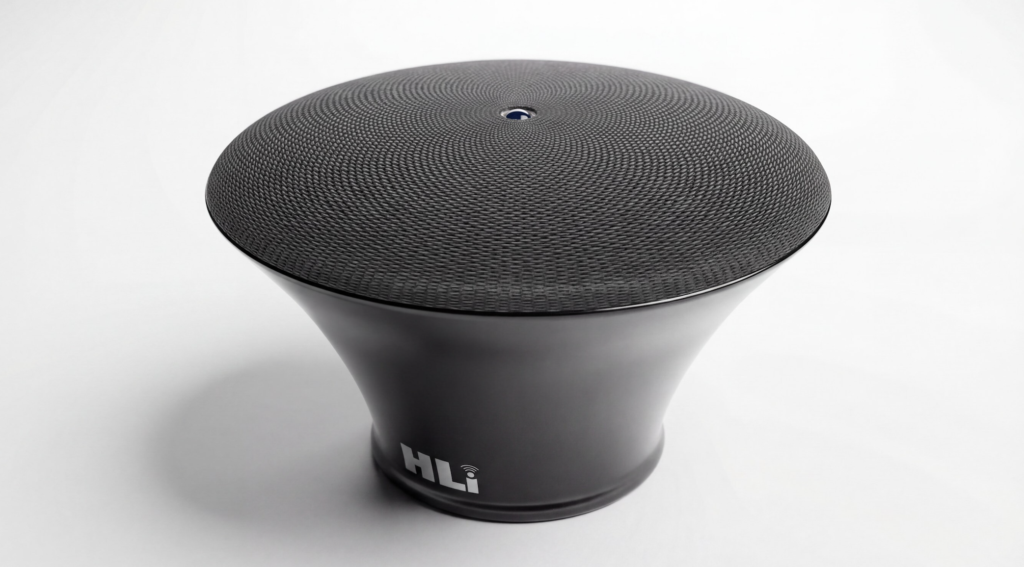
Operational flexibility is further supported by various power options, including battery, solar, and external sources. For data integration, the system features Wi-Fi, Bluetooth, and 5G connectivity to interface with broader command-and-control architectures. In a standalone configuration, a single unit provides detection up to 200 meters. When multiple units are networked, they utilize triangulated positioning to expand coverage to 500 meters, delivering precise data on target location, speed, altitude, and classification.
To enhance validation, the platform includes an optional integrated optical module, allowing operators to visually confirm threats after the acoustic sensors have identified them. This maintains a layered defense approach while preserving the stealth nature of the primary sensor.