Discover World-Leading Unmanned and Autonomous Technologies
Discover cutting-edge solutions from leading global suppliers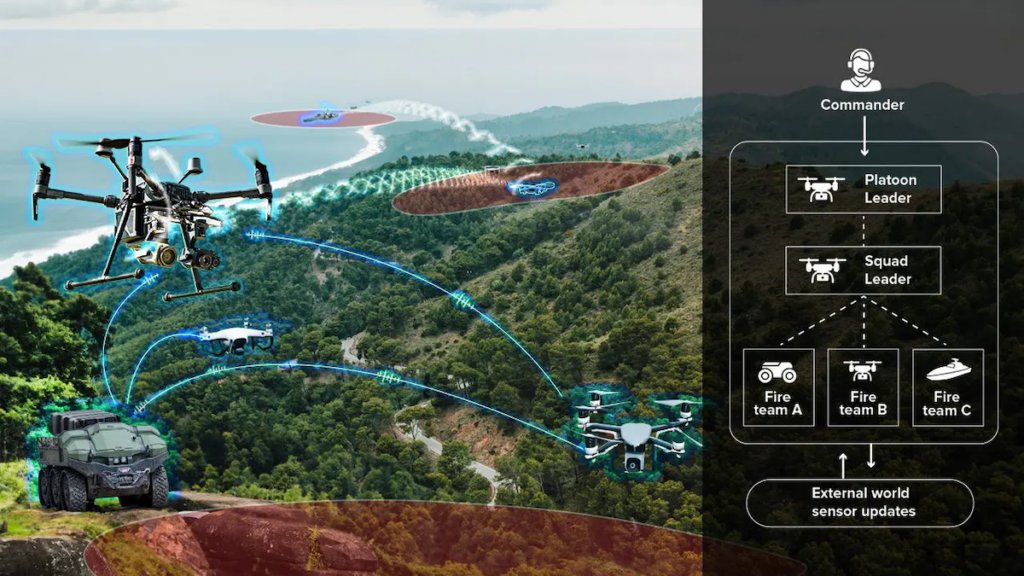
Charles River Analytics has received a multi-year contract from the Office of Naval Research to prototype and evaluate HIEROPHANT (Hierarchical Optimized Planning with Heterogeneous Autonomous Network of Tactics).
HIEROPHANT facilitates the seamless integration of resilient and adaptable autonomous systems in existing military structures, even in dynamic and communication-limited environments.
The HIEROPHANT tool comprises three key components:
- A collaborative Autonomy Framework (CAF) that provides reconfigurable and decentralized adaptation of command-and-control (C2).
- The Scruff™ probabilistic modeling framework, enabling inference about highly uncertain elements of the mission in communication-limited environments.
- A hierarchical predictive coding approach, which enables dynamic updating of mission information.
Militaries worldwide operate within strict hierarchies, expecting commands and control to follow specific protocols. Autonomous systems challenge these norms, necessitating “new types of thinking and reasoning for the AI system to be able to effectively integrate into these C2 hierarchies,” says Dr. James Niehaus, Principal Investigator on HIEROPHANT and Principal Scientist at Charles River Analytics.
A battlefield is dynamic, requiring human warfighters to adapt C2 structures to situational needs. Machines, however, often struggle to adapt quickly, needing precise instructions and data. “It’s a challenge for machines to reason in a decentralized manner when out conducting a mission, especially when they don’t always have perfect communications,” Niehaus adds.
HIEROPHANT combines technologies in planning, optimization, probabilistic reasoning, human-machine teaming, swarm robotics, machine learning, and tactical AI. While developed for military applications, it may also find use in commercial settings such as emergency search-and-rescue operations with complex logistics.
Dr. James Niehaus commented; “Autonomous systems will also be easier to adopt if they fit into existing military protocols. HIEROPHANT expertly combines many of our technologies that we have been working on for years in terms of planning, optimization, and probabilistic reasoning.
“And we’re applying this mix of capabilities—human–machine teaming, swarm robotics, probabilistic modeling, machine learning, and tactical AI—to an incredibly critical problem for the government in how to deploy autonomy at large.”
Dr. Jeff Druce, Technical Lead of HIEROPHANT and Senior Scientist, noted; “Retasking decisions must be based on a unit’s capabilities and availability, but just getting that information can be very hard.” He also described the challenge of modeling the real world as “fantastically complex.”
This work is supported by the Office of Naval Research under Contract No. N00014-24-C-2404.