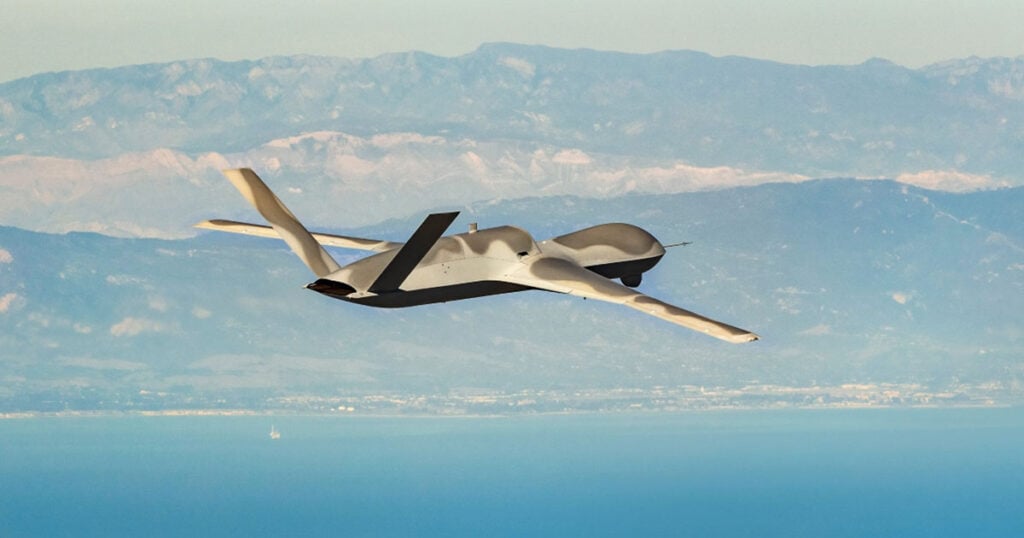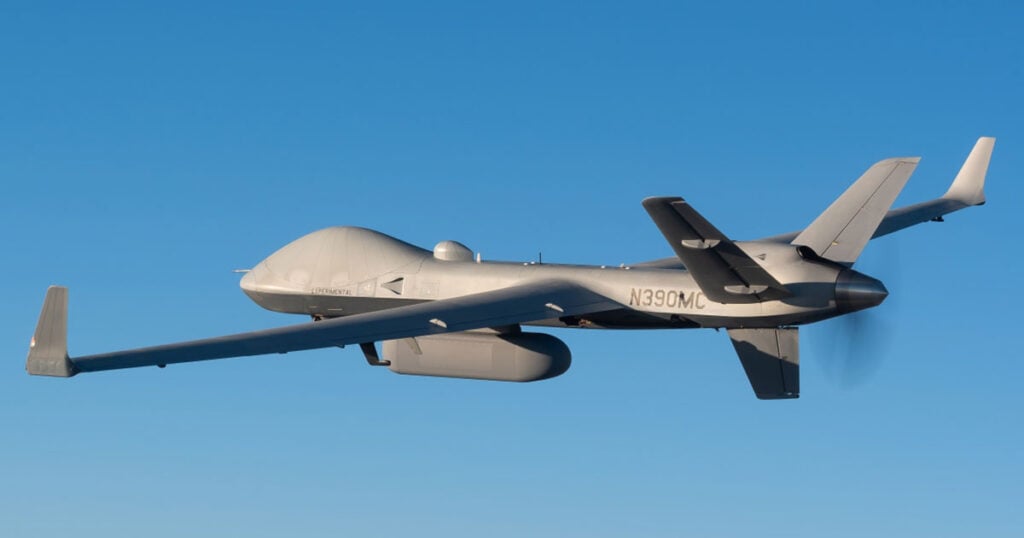
In a demonstration at General Atomics Aeronautical Systems (GA-ASI)’s Desert Horizon flight operations facility in El Mirage, California, GA-ASI, SES and Hughes Network Systems demonstrated multi-orbit SATCOM using a GA-ASI MQ-9B SkyGuardian Unmanned Aerial System (UAV).
The higher data rate SATCOM transmission featured SES’s multi-orbit satellite communications service leveraging high-throughput, low-latency Medium Earth Orbit (MEO) and Geostationary (GEO) fleet, and was powered by a Hughes HM series software-defined modem and Hughes Resource Management System.
“This demonstration proves the importance of next generation SATCOM for operators of our aircraft,” said GA-ASI Senior Vice President for MQ-9 Systems, Fred Darlington. “As we expand into new and more intricate payloads for our Remotely Piloted Aircraft, we’ll require higher data rates that provide the bandwidth, security and robustness to operate our sensors.”
The demonstration used SES’s O3b MEO system that provides fiber-like carrier-grade performance, scalability, and resilience that set the path to leveraging open architectures and achieving network sovereignty. This was used to show how unmanned aircraft, such as the GA-ASI MQ-9 series, can maintain high-workload, mission-critical connectivity and resiliency, even in contested environments.
During the demonstration, the connectivity service seamlessly roamed between O3b MEO and AMC-15 GEO satellites. SES will be launching its second-generation MEO system, O3b mPOWER, in late 2022 to further support governments through unprecedented performance, waveform-agnostic service and enabling network sovereignty.
“We are very proud of our partnership developed over the years between SES, GA-ASI and their government customers. Innovation is the key in supporting transformational changes in the ISR services, and this demonstration is one more example of how the industry can work together to bring something special to market,” said Will Tong, Vice President of Strategic Government Initiatives and head of the Aero ISR market at SES. “Together with GA-ASI, we were able to prove out new levels of secure, flexible and high-performance multi-orbit services for ISR, with 10x performance on a significantly smaller form factor, with increased resiliency and security for the end users.”
Integrated onto the MQ-9B, the milspec Hughes HM System modem (HM400) powered the MEO and GEO SATCOM with Low-Probability of Intercept/Low Probability of Detection (LPI/LPD) modes for the resiliency necessary in congested and contested environments.
Together with the Hughes Resource Management System, the HM400 automatically optimized and switched satellite signals smoothly and within seconds, demonstrating a near real-time capability that enhances the military’s Primary Alternative Contingency Emergency (PACE) planning.
“Working together with General Atomics for many years, we are pleased to support the MQ-9B program with the commercially based Hughes HM400 modem integrated as the standard for real-time communications for beyond line of sight mission opportunities,” said Rick Lober, Vice President and General Manager, Hughes Defense. “Combined with the Hughes Resource Management System, the frequency-agnostic, open architecture HM System helps GA-ASI meet their military customer’s requirements for uninterrupted, high data rate, multi-orbit SATCOM, ensuring secure information accessibility for the right people at the right time.”
Find suppliers & developers of SATCOM Systems & Equipment for Drones & UAVs >>