


WOLF Advanced Technology
HP | MJF for Unmanned Systems
General Atomics Aeronautical Systems, Inc

Avenger UAS Autonomously Send Merged Air Threat Data to Ground Station

By Caroline Rees / 12 Jan 2022
Follow UST

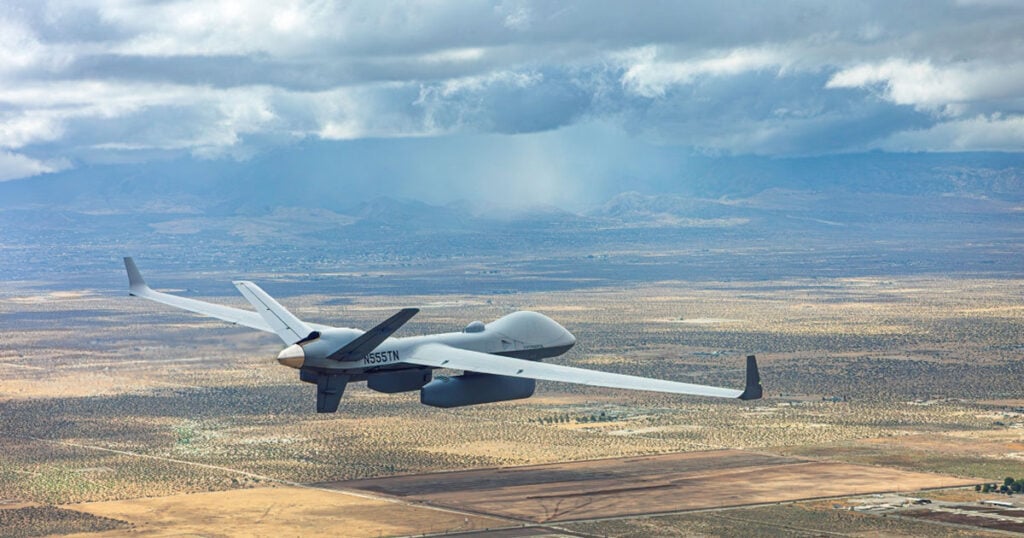
General Atomics Aeronautical Systems, Inc. (GA-ASI) has used two company-owned Avenger Unmanned Aerial Systems (UAS), each equipped with a Lockheed Martin Legion Pod, to send long-range air threat data captured passively and fused by an advanced sensor algorithm to a Command Center.

In the two-hour flight, the Avengers flew over the desert of southern California. During the flight, Legion Pod’s Infrared Search and Track system (IRST21) detected multiple fast-moving aircraft operating in the area. On-pod Lockheed Martin fusion software blended the sensor data from both pods in real time and the Avengers streamed it to the ground station.

“This first-time, industry-funded flight test demonstrates the maturing capabilities of UAS and sensors to deliver fused sensor data,” said GA-ASI Senior Director of Advanced Programs, Michael Atwood. “Avenger with Legion Pod demonstrates how collaborative autonomous platforms with advanced sensing can deliver persistent, shared air domain awareness.”

“This is the first time IRST systems on multiple autonomous aircraft have delivered merged air threat data to users on the ground,” said Scott Roberson, director of Sensors and Global Sustainment Advanced Programs at Lockheed Martin. “It’s a big step in developing a common operating picture that boosts situational awareness across domains in joint operations.”

This fusion technology was previously tested in F-15-equipped Legion Pods and datalinks at the Northern Edge operational exercise earlier this year. Legion Pod is a proven long-range passive IRST sensor on multiple platforms including two types of Avenger UAS. Since Legion Pod is in production, it could fly real-world missions as soon as U.S. Government customers would like if there was an urgent need.

The fusion engine’s ability to take in multiple sensor sources makes it a central node that connects Legion Pods on manned and unmanned platforms. Lockheed Martin has plans to test the Legion Pod with datalink capability among F-16s as well as F-15-to-F-16 sensor fusion. The sensor’s open design readily supports Joint All Domain Operations requirements for alternative datalink architectures.

The Open Mission System (OMS) architecture of the Legion Pod sensor allows for rapid integration, making the technology transportable among aircraft platforms and reducing the timeline and complexity to integrate on new platforms. 

Find suppliers & manufacturers of Unmanned Aerial Vehicles >>

To learn more, visit the General Atomics Aeronautical Systems, Inc Partner Hub: Innovation Partner Hub
Posted by Caroline Rees Caroline co-founded Unmanned Systems Technology and has been at the forefront of the business ever since. With a Masters Degree in marketing Caroline has her finger on the pulse of all things unmanned and is committed to showcasing the very latest in unmanned technical innovation. Connect

More from General Atomics Aeronautical Systems, Inc

Thirteen Dutch Innovators Selected to Pitch Defense & Dual-Use Technologies at Blue Magic Netherlands

Featuring keynotes from senior military and NATO leaders, thirteen Dutch tech companies prepare to pitch cutting-edge solutions addressing critical defense challenges to industry decision-makers at the Eindhoven innovation event

Nov 05, 2026
GA-ASI Opens North Dakota Facility for Remote MQ-9A Operations

GA-ASI has opened a new Remote Split Operation (RSO) facility in North Dakota to support MQ-9A aircraft missions for U.S. Africa Command, reducing overseas personnel requirements and operational costs through US-based remote flight operations

Nov 03, 2026
GA-ASI & Saab Demonstrate Uncrewed Airborne Early Warning Flight Capabilities on MQ-9B

Flight trials in California paired General Atomics’ long-endurance uncrewed aircraft with Saab’s advanced radar to track multiple airborne and maritime targets, transforming persistent surveillance while eliminating operational risk to crewed platforms

Oct 29, 2026
GA-ASI & Spirit Defense Partner to Scale Collaborative Combat Aircraft Production

GA-ASI has partnered with Spirit Defense to manufacture fuselages for the Air Force's FQ-42 Collaborative Combat Aircraft, significantly expanding industrial capacity to accelerate autonomous military fleet production

Oct 27, 2026
GA-ASI Flight Tests New ESM System for Long-Range Sensing on Army Gray Eagle UAS

GA-ASI has completed successful flight testing of SNC's Electronic Support Measures system on the MQ-1C Gray Eagle ER, enhancing long-range threat detection and survivability for U.S. Forces

Oct 19, 2026
Arizona Army National Guard to Receive First Gray Eagle® 25M UAS

General Atomics Aeronautical Systems plans to deliver eight Gray Eagle® 25M unmanned aircraft to the Arizona Army National Guard in September 2027, with four additional units scheduled for fielding by the end of 2029 as part of a wider initiative to establish eight divisional UAS companies

Oct 14, 2026

THE WEEKLY eBRIEF

The latest unmanned systems news, straight to your inbox.

Get our weekly roundup of technology developments, new products and industry news.

By subscribing, you agree to receive the weekly UST eBrief newsletter from EchoBlue Ltd. Unsubscribe at any time using the link in every email. See our Privacy Notice.

Advancing Unmanned Systems Through Strategic Collaboration UST works with major OEMs to foster collaboration and increase engagement with SMEs, to accelerate innovation and drive unmanned systems capabilities forward.