


WOLF Advanced Technology
HP | MJF for Unmanned Systems
General Atomics Aeronautical Systems, Inc

New Predator B Extended Range RPA Completes First Endurance Flight

By Caroline Rees / 21 Jul 2014
Follow UST
Predator B ER

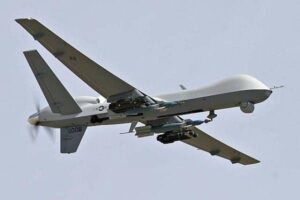
The Predator® B Extended Range (ER) RPA

General Atomics Aeronautical Systems, Inc. (GA ASI), a leading manufacturer of Remotely Piloted Aircraft (RPA) systems, radars, and electro-optic and related mission systems solutions, today announced the successful second endurance flight of its Predator® B Extended Range (ER) RPA, an advanced derivative of the mission-proven Predator B RPA that has accumulated over 800,000 flight hours since 2001. The flight launched on June 17 and landed on June 18.

“This flight was a significant milestone for Predator B ER in that it closes out its Phase 1 flight test period,” said Frank W. Pace, president, Aircraft Systems, GA-ASI. “The entire RPA system was successfully tested from start to finish, including flying a real-world representative mission with significant loiter time, and then returning to base.”

During the flight, Predator B ER demonstrated its ability to carry an external fuel tank on each wing and showed the utility of a new fuel management system which ensures fuel and thermal balance amongst all fuel sources, including the external tanks, the wing, and the fuselage. Additionally, the aircraft demonstrated its Alcohol Water Injection (AWI) system, which provides tremendous value by shortening the required runway takeoff length, especially at higher gross takeoff weights, higher altitude take-offs, and on hot days. AWI also improves climb out performance and fuel efficiency.
Additional testing will be conducted into 2015 to validate other mission profiles and aircraft configurations.

GA-ASI introduced Predator B ER in April 2012 in an effort to extend Predator B’s already impressive endurance and range greatly while increasing its operational flexibility further. The aircraft first took flight in February of this year, and the company is currently under contract with the U.S. Air Force to build 38 Predator B/MQ-9 Reaper® RPA under the ER option that optimizes the aircraft for Intelligence, Surveillance, and Reconnaissance (ISR) missions with a projected increase in endurance from 27 to 33-35 hours by adding two external fuel tanks to its existing wings and heavy-weight landing gear to accommodate an increase in maximum gross takeoff weight. At the same time, GA-ASI is using Internal Research and Development (IRAD) funds to develop an add-on ER option that optimizes the aircraft for multi-purpose missions with a projected increase in endurance from 27 to 42 hours for ISR-only by replacing its current fuel-filled 66-foot wings with 79-foot wings. Completion of the first fuel-filled, longer wing is expected this summer, with the first test flight to follow before the end of the year.


To learn more, visit the General Atomics Aeronautical Systems, Inc Partner Hub: Innovation Partner Hub
Posted by Caroline Rees Caroline co-founded Unmanned Systems Technology and has been at the forefront of the business ever since. With a Masters Degree in marketing Caroline has her finger on the pulse of all things unmanned and is committed to showcasing the very latest in unmanned technical innovation. Connect

More from General Atomics Aeronautical Systems, Inc

Thirteen Dutch Innovators Selected to Pitch Defense & Dual-Use Technologies at Blue Magic Netherlands

Featuring keynotes from senior military and NATO leaders, thirteen Dutch tech companies prepare to pitch cutting-edge solutions addressing critical defense challenges to industry decision-makers at the Eindhoven innovation event

Nov 05, 2026
GA-ASI Opens North Dakota Facility for Remote MQ-9A Operations

GA-ASI has opened a new Remote Split Operation (RSO) facility in North Dakota to support MQ-9A aircraft missions for U.S. Africa Command, reducing overseas personnel requirements and operational costs through US-based remote flight operations

Nov 03, 2026
GA-ASI & Saab Demonstrate Uncrewed Airborne Early Warning Flight Capabilities on MQ-9B

Flight trials in California paired General Atomics’ long-endurance uncrewed aircraft with Saab’s advanced radar to track multiple airborne and maritime targets, transforming persistent surveillance while eliminating operational risk to crewed platforms

Oct 29, 2026
GA-ASI & Spirit Defense Partner to Scale Collaborative Combat Aircraft Production

GA-ASI has partnered with Spirit Defense to manufacture fuselages for the Air Force's FQ-42 Collaborative Combat Aircraft, significantly expanding industrial capacity to accelerate autonomous military fleet production

Oct 27, 2026
GA-ASI Flight Tests New ESM System for Long-Range Sensing on Army Gray Eagle UAS

GA-ASI has completed successful flight testing of SNC's Electronic Support Measures system on the MQ-1C Gray Eagle ER, enhancing long-range threat detection and survivability for U.S. Forces

Oct 19, 2026
Arizona Army National Guard to Receive First Gray Eagle® 25M UAS

General Atomics Aeronautical Systems plans to deliver eight Gray Eagle® 25M unmanned aircraft to the Arizona Army National Guard in September 2027, with four additional units scheduled for fielding by the end of 2029 as part of a wider initiative to establish eight divisional UAS companies

Oct 14, 2026

THE WEEKLY eBRIEF

The latest unmanned systems news, straight to your inbox.

Get our weekly roundup of technology developments, new products and industry news.

By subscribing, you agree to receive the weekly UST eBrief newsletter from EchoBlue Ltd. Unsubscribe at any time using the link in every email. See our Privacy Notice.

Advancing Unmanned Systems Through Strategic Collaboration UST works with major OEMs to foster collaboration and increase engagement with SMEs, to accelerate innovation and drive unmanned systems capabilities forward.