
The Tactien Group has announced comprehensive support services for end-users investing in Counter UAS (C-UAS) technology investments.
The bespoke offering consists of industry education, vetting, validation, and commissioning support services designed to give critical infrastructure operators an independent, data-driven basis for UAS detection procurement decisions.
The market includes capable systems built by legitimate companies and many of them genuinely perform well, in the right environment. The challenge for end-users is that ‘right environment’ is the operative phrase. Across a price spectrum that runs from thousands to millions, Tactien’s role is to give buyers the environment-specific evidence they need to make a confident, defensible procurement decision.
The service addresses a gap that has become increasingly visible as the C-UAS market expands organizations. Those responsible for protecting data centers, energy facilities, and other high-value assets are being asked to make multi-million-dollar procurement decisions without a clear understanding of CUAS regulations, varying performance capabilities, and massaged test data. Tactien’s offering removes those dependencies entirely.
“Vendor validation data is often collected in controlled environments. Our job is to remove that control on behalf of the end-user. It’s amazing how different one system will perform in one environment versus another.” — Nate Ernst, Founder & President, Tactien Group
A SIX-STEP PROCESS BUILT AROUND THE CUSTOMER’S ENVIRONMENT
Tactien’s process begins before any hardware is evaluated. The first phase focuses on education walking clients through how C-UAS detection technologies work (RF, radar, optical, acoustic, multi-sensor fusion, etc.), the current regulatory framework, and the true cost of program ownership across a price spectrum. Pricing for hardware alone can range from $5,000 basic sensors to $2M+ integrated platforms.
From there, Tactien works with the client to define their specific requirements: asset risk profiles, operational performance criteria, system architecture needs, and vendor support requirements. The output of this phase is a customer-specific RFP issued to C-UAS vendors, who are then filtered by budget and capability before any live testing begins.
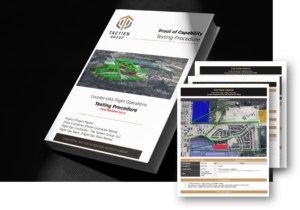
Figure SEQ Figure \* ARABIC 2 Tactien Testing Procedure – CUAS Flight Ops
The live testing phase is where Tactien’s methodology is most distinct. Operating as a blind red-team, Tactien will design and execute a UAS test procedure on site for the customer, flying many different aircraft types over multiple days, stress testing different flight profiles and configurations. Down-selected vendors are given no advanced information on aircraft type, flight path, frequency, or timing. Test profiles are specifically designed based on the customer’s risk profile for UAS incursion and can cover:
- Varying altitudes, speeds, and times of day including night operations
- Multi-aircraft and simultaneous swarm sorties
- Terrain masking, EMF spoofing, and hillshade exploitation
- Obstacle and urban canyon environments
- Varying RF signature profiles including custom platforms
- Group 2 & 3 UAS for advanced threat simulation
SOFTWARE BUILT OUT OF NECESSITY
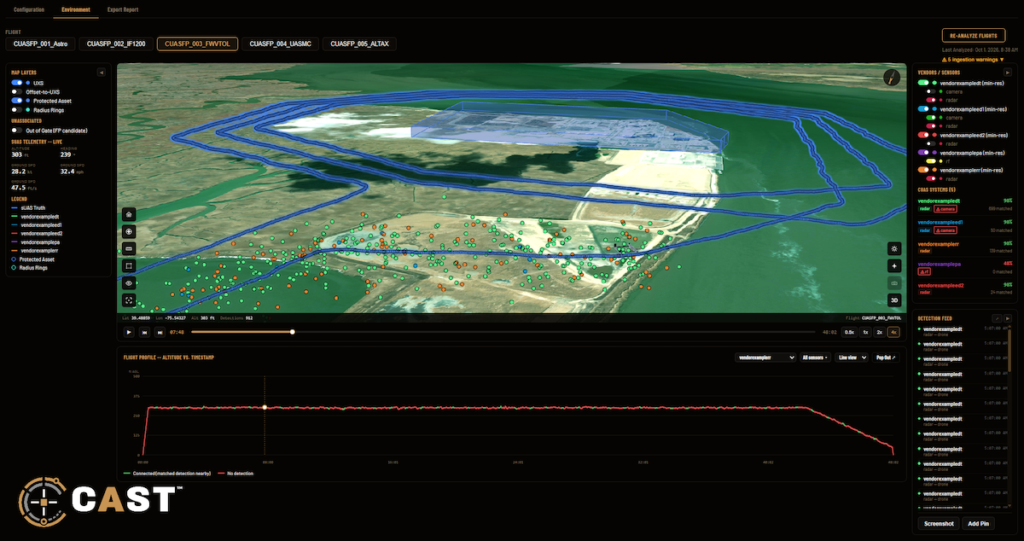
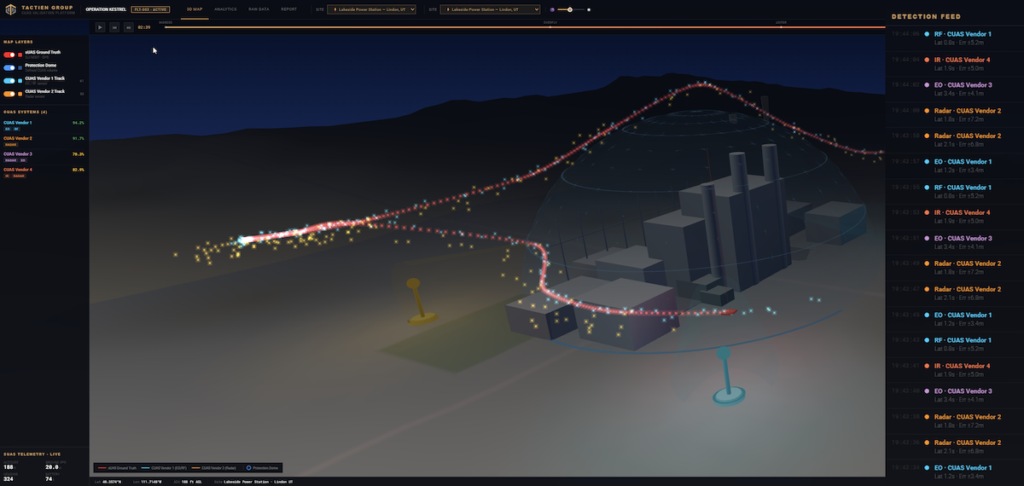
Finding no commercially available tool capable of performing the required analysis, Tactien built its own. The platform ingests GPS telemetry from every sortie alongside each vendor’s detection output, then calculates many KPIs. That data is displayed in a 3D environment that replays each drone flight against each vendor’s tracking data, with variance scores.
“Often times, vendors will show up with synonymous components (i.e., the same radar in each tech stack). However, the radar performance between each vendor can be drastically different. There are many factors for this, but the only source of truth for a potential buyer is to stress test them side-by-side in their specific environments.”
The platform scores all vendors against a pre-defined KPI framework and aggregates results into side-by-side scorecards. Some of the KPIs include detection rate (Pd), tracking continuity, positional accuracy, latency, false positive rate, and classification accuracy. Because the software was developed by Tactien, they can add custom KPIs per customer requirement.
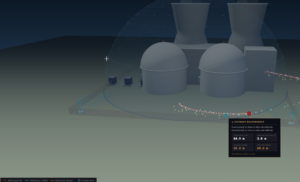
Figure SEQ Figure \* ARABIC 3 Tactien CUAS Analysis Platform
PERFORMANCE IS SITE-SPECIFIC
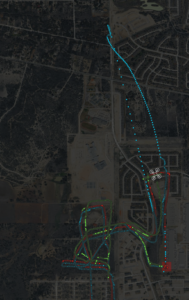
Figure SEQ Figure \* ARABIC 4 Varying performance of CUAS vendors, side-by-side
One major finding from Tactien’s work is that C-UAS performance does not transfer between environments. Multiple systems incorporating the identical subcomponent from the same manufacturer can produce measurably different detection results. A system that ranked first for one end-user can perform poorly when stress-tested for another.
This environment specificity exacerbates the need for independent, customer-specific testing. Benchmarking one system across multiple engagements is a mistake. While a validated system in one geographic region/environment suggests it may perform well in another, there is simply not enough historical data to justify investment.
The financial stakes are real. One client’s evaluation identified a top-tier system reporting drone positions nearly two miles from their actual location, a failure that would have rendered the system operationally useless at that site.
FINAL REPORT AND OPTIONAL COMMISSIONING
At the conclusion of testing, Tactien delivers a final report containing:
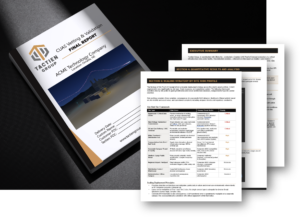 Per-flight vendor scorecards ranked by performance category
- Side-by-side comparative analytics showing exactly where each vendor outperforms the others, and why
- Site-specific assessment of how local RF conditions, terrain, and interference affected performance
- Clear documentation of detection gaps per system and under what conditions they occurred
- Quantitative proof of performance with vendor recommendation(s) and justified reasoning.
For organizations wanting end-to-end support, Tactien’s service extends through commissioning, covering hardware installation, system integration, operator training, multi-site scaling strategy, and development of a company C-UAS response policy, including coordination with local, state, and federal agencies.
Service Tiers
| TIER | SCOPE |
|---|---|
| LEVEL 1
Education & Strategy |
|
| LEVEL 2
Validation & Selection |
|
| LEVEL 3
Full Program Integration |
|
THE TEAM BEHIND THE SERVICE
Tactien’s C-UAS team brings together decades of combined experience across aviation operations, federal defense programs, airspace policy, and systems engineering. The team includes operators with extensive Group 1-4 UAS and complex airspace experience, former senior federal agency leaders in UAS security and critical infrastructure protection, and defense program managers with backgrounds in DoD systems qualification and multi-agency coordination.
Beyond the core team, Tactien operates through a close network of specialist partners for extended service areas including system integration, commissioning, and regulatory and policy development, ensuring clients have access to the right expertise at every phase of their program, regardless of scope or scale.
For more information on Tactien Group’s Counter-UAS Vetting, Validation, and Commissioning service, visit the Tactien Group website.