Discover World-Leading Unmanned and Autonomous Technologies
Discover cutting-edge solutions from leading global suppliersAhead of Oceanology International 2026 and the launch of the new COAST exhibition zone, Paige Roepers, CEO of Ocean Ledger, is drawing attention to what she identifies as a significant gap in climate risk assessment: the persistent underpricing of chronic coastal erosion.
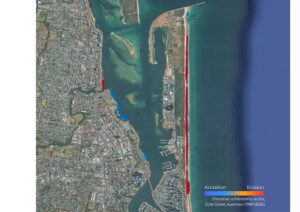
Accretion and erosion trends along the Gold Coast, Australia, between 1990 and 2025. Credit: Ocean Ledger
While acute hazards such as hurricanes and extreme flooding dominate financial risk frameworks, gradual shoreline retreat continues to diminish asset value, municipal stability, and long-term coastal viability with far less visibility.
Through her work at Ocean Ledger, Roepers emphasizes the need to close the gap between geological processes and financial valuation. The company is developing stochastic coastal modeling tools intended to incorporate long-term erosion dynamics into the quantitative systems that influence insurance pricing, adaptation funding, and capital allocation.
Acute Events Dominate Risk Models While Chronic Loss Escalates
Financial and insurance markets have traditionally focused on sudden, high-impact hazards. These events align with conventional insurance structures designed to respond to statistically infrequent but severe losses. In contrast, erosion is typically excluded from standard homeowners policies because it is classified as a predictable process rather than a discrete, insurable occurrence.
Roepers argues that this distinction contributes to systematic mispricing of coastal assets. Environmental, social, and governance assessments frequently reflect present-day inundation exposure but may not account for progressive land loss. In some regions, erosion rates can reach up to two meters per year, increasing not only exposure to future flooding but also the risk of operational disruption where shoreline proximity or beach access supports economic activity.
The consequences extend beyond individual property owners. Mortgage lenders, municipal tax bases, and bond ratings may all be affected as land degradation accelerates. Over time, cumulative losses associated with chronic erosion can exceed the financial impact of a single extreme storm.
From Resistance to Resilience in Coastal Management
Historically, erosion management has centered on defensive infrastructure such as seawalls and bulkheads intended to prevent shoreline retreat. While these measures may provide localized protection, heavily engineered approaches can alter sediment transport patterns and intensify erosion in adjacent areas.
Current coastal management practice increasingly emphasizes resilience rather than rigid defense. Nature-based measures including dune restoration, living shorelines, and wetland preservation can reduce storm energy while slowing long-term land loss. These green and blue infrastructures serve as protective assets but require sustained investment and maintenance. From a financial perspective, they can be treated as depreciating infrastructure assets comparable to other forms of critical utility.
Integrating Chronic Change Into Financial Models
Ocean Ledger characterizes coastal erosion as both a technical and financial challenge. The technical issue arises when gradual change is treated as background variability, even when cumulative impacts surpass those of individual acute events. The financial issue stems from risk systems that primarily assign value to hazards that produce immediate, trigger-based losses.
To address this gap, the company is building stochastic coastal modeling tools that incorporate sub-peril drivers such as erosion over time, expressed in probabilistic terms similar to those used in hurricane risk assessment. The objective is to embed chronic shoreline change within the models that influence capital flows, including insurance underwriting and adaptation planning.
Broader market innovation includes instruments such as Blue Bonds that seek to monetize the protective value of healthy ecosystems. However, Roepers stresses that meaningful progress depends on integrating high-resolution elevation data, including LiDAR, with forward-looking climate projections to enable proactive risk management rather than reactive claims handling.
COAST at Oceanology International 2026
COAST at Oceanology International, officially supported by Unmanned Systems Technology, has been established as a dedicated hub for professionals responsible for coastal and nearshore assets. The zone convenes coastal and port engineers, hydrographic surveyors, geospatial and GIS specialists, environmental consultants, marine data experts, planners, port authorities, and public agencies.
The exhibition and theatre programming focus on solutions for high-energy and dynamic nearshore environments, including rocky coasts, sandy beaches, estuaries, and navigation channels. Attendees can evaluate technologies for coastal protection, erosion control, sediment transport analysis, shoreline stabilization, and nature-based adaptation. Survey systems, sensing platforms, modeling tools, and marine data services are central to discussions aimed at improving infrastructure planning and environmental stewardship.
Ocean Ledger will exhibit at Stand S300 during Oceanology International 2026, held at Excel London from March 10 to 12, 2026. The event is expected to bring together more than 8,000 participants representing every continent, providing an international forum to examine how coastal erosion is increasingly recognized not only as an environmental concern but also as a material balance-sheet issue for coastal economies.