Tethered Drones
Discover cutting-edge solutions from 4 leading global suppliers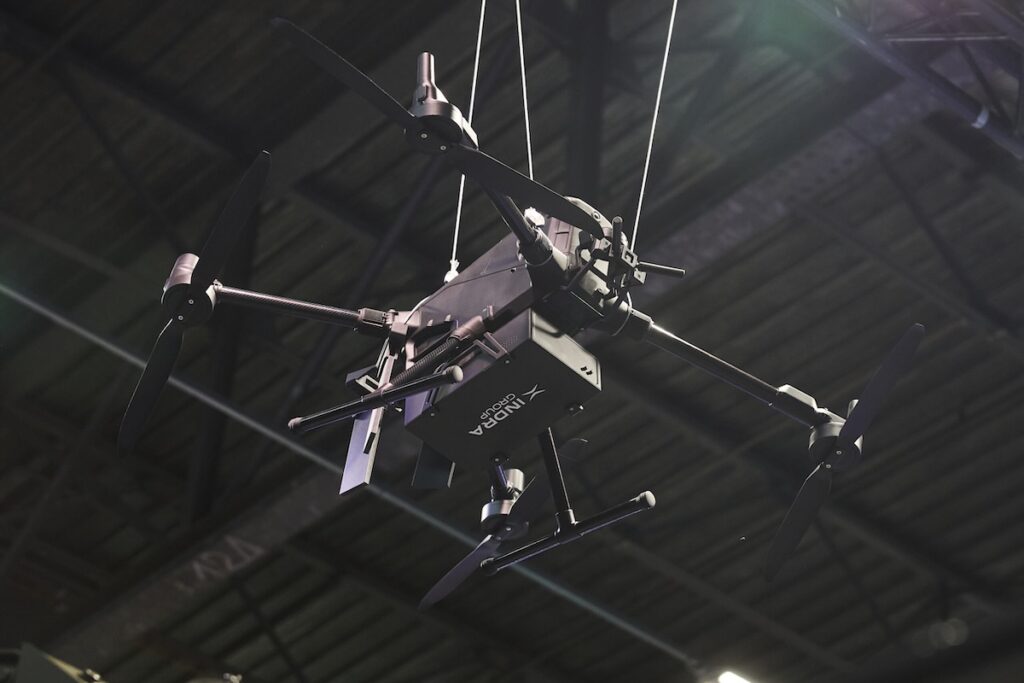
Indra Group has presented an innovative electronic warfare system mounted on a tethered drone operating from a 4×4 tactical vehicle at Eurosatory, marking a significant expansion into the emerging European lightweight electronic warfare segment.
The newly unveiled system utilizes a quadcopter equipped with electronic warfare payloads in the communications band. By elevating these sensors more than 100 meters into the air, the platform extends its operational range by tens of kilometers, enabling the detection and identification of adversary voice communications, data, and the remote-control links used by enemy drones. When deployed on a tactical vehicle, the system actively protects advancing units on the move by disrupting the adversary’s ability to coordinate maneuvers and attacks.
This development addresses a major shift in modern military requirements. A representative at Indra Group explains that “the lessons learned in Ukraine have led armed forces to demand a new type of much lighter electronic warfare system, with a more tactical character and conceived to operate as a node in a network”. Unlike traditional electronic warfare systems that rely on large command centers and powerful ground stations positioned safely in the rear, these new lightweight systems are simpler, more affordable, and designed to operate close to the frontline where they can be easily replaced if necessary.
Indra Group is developing this entire range of systems for integration across multiple platforms, including aerial drones of various sizes, unmanned ground vehicles, and light tactical vehicles. This initiative is part of the Special Deployable Electronic Warfare Modernization Program for the Spanish Army and Navy, which the company currently leads.
To maximize battlefield flexibility, the systems designed for tactical vehicles share a common configuration that permits rapid transfer between different platforms. They can also function independently, mounted on tripods at fixed positions or carried by soldiers in backpacks to operate remotely from areas of interest. Each unit features autonomous command and control capabilities and can integrate into networked mesh architectures, allowing individual sensors to send data to command centers and help construct the overarching electronic order of battle.
The hardware capabilities are supported by the company’s IndraMind platform, which provides an advanced cognitive layer for highly effective data analysis and fusion. IndraMind implements simplified interfaces that allow any soldier to operate the system without specialized training, minimizing preparation requirements. Additionally, the platform provides real-time translation of intercepted communications, removing the need for an on-board translator.
This range of solutions allows Indra Group to adapt its systems to the specific needs of various global armed forces, whether they require vehicle-integrated setups, wide-area deployable sensors, or expendable jamming systems. The company maintains a broad global footprint in electronic warfare across land, air, and naval domains, supplying command and control solutions, deployable electronic support and countermeasures stations, airborne signals intelligence systems, aircraft electronic warfare pods, directional infrared countermeasures protection systems, and electronic attack solutions.