Meteorological Drones
Discover cutting-edge solutions from leading global suppliers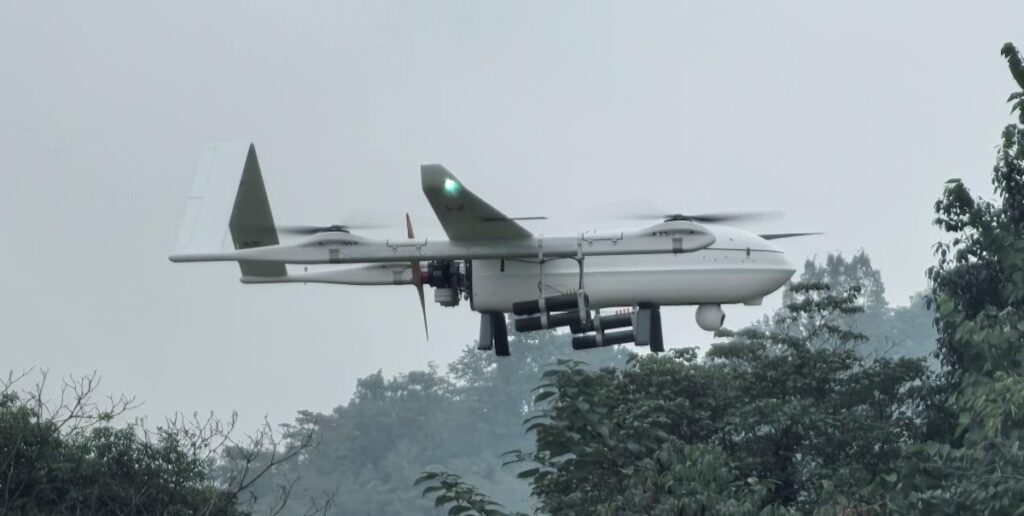
JOUAV has introduced the CW-80E, a Vertical Take-Off and Landing (VTOL) Unmanned Aerial System (UAS) designed specifically for weather modification missions such as cloud seeding and precipitation enhancement.
As global demand grows for precise, cost-effective weather modification, unmanned systems are increasingly serving as a viable alternative to traditional manned aircraft. Built on a large fixed-wing platform, the CW-80E is engineered to improve operational efficiency and safety by reducing reliance on manned flights and enabling remotely executed operations with precise payload activation. Integrated flight control and payload management systems support consistent execution under variable atmospheric conditions.
The platform is configured to carry warm cloud flares and a cloud particle imaging payload, allowing operators to analyze cloud microphysical conditions and execute targeted seeding. Operators can remotely trigger onboard ignition within designated altitudes and defined airspace to support the controlled dispersal of seeding agents. This framework supports multiple environmental applications, including rainfall and snowfall enhancement, hail suppression, and forest fire prevention.
With a maximum takeoff weight of 100 kg and a 5-meter wingspan, the system is tailored for large-scale deployment scenarios. It features a maximum payload capacity of up to 25 kg and an operational flight endurance of up to 480 minutes, or approximately 8 hours, depending on the configuration. This enables both wide-area and long-duration atmospheric missions.
The drone cruises at approximately 100 km/h and can reach operational altitudes of up to 5,000 meters. It delivers an operational radius of 100 to 200 km, covering expansive target regions within a single mission. Designed for complex and high-altitude environments, the hardware functions in temperatures ranging from -20°C to 55°C and can withstand wind conditions up to around 17 m/s.
Because the system utilizes VTOL capability, it can be deployed in regions with limited infrastructure or challenging terrain where conventional aircraft operations are typically constrained. This launch reflects a broader industry expansion in utilizing medium- and large-sized Unmanned Aerial Vehicles (UAV) for environmental management and atmospheric intervention, providing agencies with flexible, scalable tools for weather-related operations.