Discover World-Leading Unmanned and Autonomous Technologies
Discover cutting-edge solutions from leading global suppliers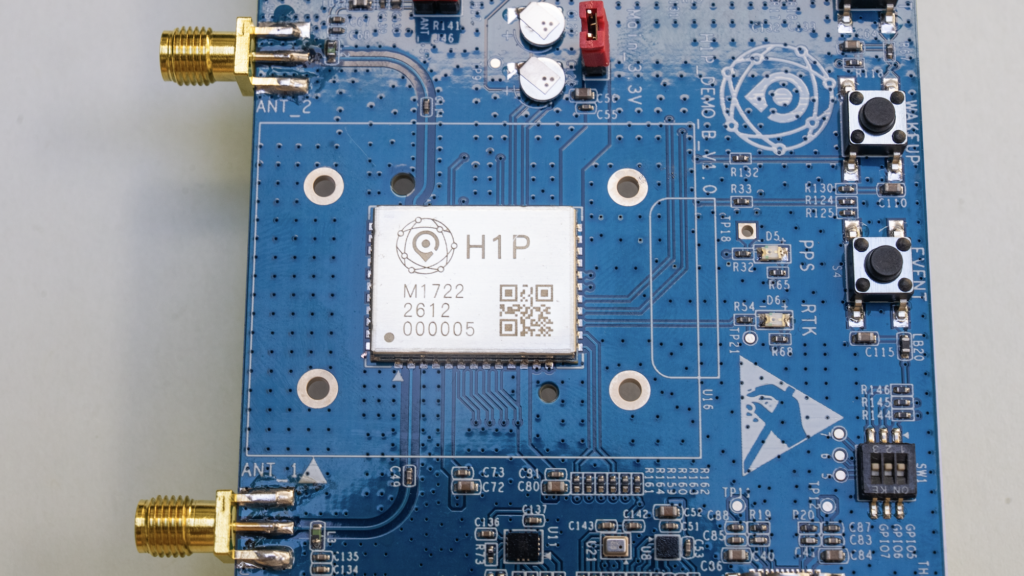
HYFIX Spatial Intelligence samples and evaluation kits are now available for the H1P Positioning, Navigation, and Open-Compute Module.
The new module integrates the company’s H1 Autonomous Systems Chip into an industry-standard form factor, allowing engineers to consolidate multiple electronic subsystems into a single unit. This design aims to simplify the integration process for small unmanned aircraft while improving overall system reliability.
Mike Horton, CEO of HYFIX, said, “H1P is about bringing the core systems of a drone into one place. Instead of treating positioning, navigation, and compute as separate problems, we’ve integrated them at the silicon level. That simplifies integration, improves reliability, and gives developers more control over how their systems perform in the real world.”
The development of the H1P addresses growing requirements for domestic drone components. As policy shifts like the Federal Communications Commission Covered List place greater emphasis on trusted domestic suppliers, the U.S.-designed H1 chip provides an alternative to non-U.S. vendors. By replacing several discrete electronic components, the architecture supports more secure and scalable high-volume manufacturing within the United States.
Technically, the H1P features dual RF ports supporting dual-antenna GNSS operation with over 800 hardware tracking channels. It is compatible with all major global navigation satellite systems and includes support for Pulsar, a high-power, low-Earth orbit (LEO) navigation service from Xona.
Bryan Chan, Co-founder and VP of Strategy at Xona, added, “GNSS alone is no longer sufficient for modern unmanned systems operating in contested and degraded environments. With support for Pulsar’s high-power, authenticated signals, Hyfix is setting a new baseline for precision and resilience in a module ready for real-world deployment.”
To handle degraded environments or jamming attempts, the module combines LEO signals with integrated Inertial Measurement Unit (IMU) sensor fusion. It also utilizes correction data from GEODNET to enable anti-spoofing and high-accuracy real-time kinematic (RTK) positioning.
The hardware is built on a dual-CPU architecture and serves as an open-compute platform. It is compatible with the PX4 Autopilot ecosystem and runs on the NuttX operating system, providing onboard compute and I/O resources for system customization. The module’s 17 × 22 mm surface-mount form factor is designed to be physically compatible with many existing GNSS modules currently on the market.
HYFIX is demonstrating the H1P at AUVSI Xponential 2026, where the company is providing live demonstrations and processing evaluation kit requests for qualified customers.