Defense Drones
Discover cutting-edge solutions from 6 leading global suppliers
DZYNE Technologies has officially unveiled Blitz, a next-generation expendable Group 1 Unmanned Aerial System (UAS) engineered to deliver affordable mass, rapid adaptability, and autonomous operations.

The system addresses the defense community’s urgent need to field small, smart, and cost-disruptive unmanned systems at scale, reflecting lessons from contemporary conflicts and Department of War priorities around attritable, open, and interoperable platforms. Designed for multi-mission flexibility and high-volume swarm deployment, the aircraft will be on display at SOF Week 2026, Booth #2221.
Connor Toler, Blitz Product Manager at DZYNE, commented, “Blitz represents a fundamental shift in how warfighters can project mass, adaptability, and speed. By pairing true affordability with a deeply modular architecture, Blitz gives operators the freedom to scale missions on demand, from single asset reconnaissance to synchronized multi aircraft effects. It’s designed to be trained quickly, deployed anywhere, and integrated with existing digital ecosystems without friction.”
Built as a cost-effective, high-volume platform, the vehicle features a foldable, packable airframe that fits within an 80L rucksack for small-unit operations. It can be assembled and mission-ready in under two minutes, yet easily scales to support larger distributed and attritable force employment. Open interfaces and Payload Development Kits aligned with Modular Open Systems Approach principles allow seamless integration of DZYNE payloads, third-party modules, and end-user-developed systems.

Engineered for performance uncommon in the expendable Group 1 class, the aircraft delivers a range of approximately 80 to 150 km without forward staging and an endurance of 1 to 2 hours, with long-endurance battery options available. It operates within a cruise envelope speed of 40 to 75 KEAS, offers a payload capacity of up to 5 lbs. for intelligence, surveillance, and reconnaissance (ISR), electronic warfare (EW), deception, and other mission effects, and utilizes quiet electric propulsion to enable low-visibility operations. Native ATAK and MAVLink integration further simplifies adoption by allowing incorporation into current command and control ecosystems.
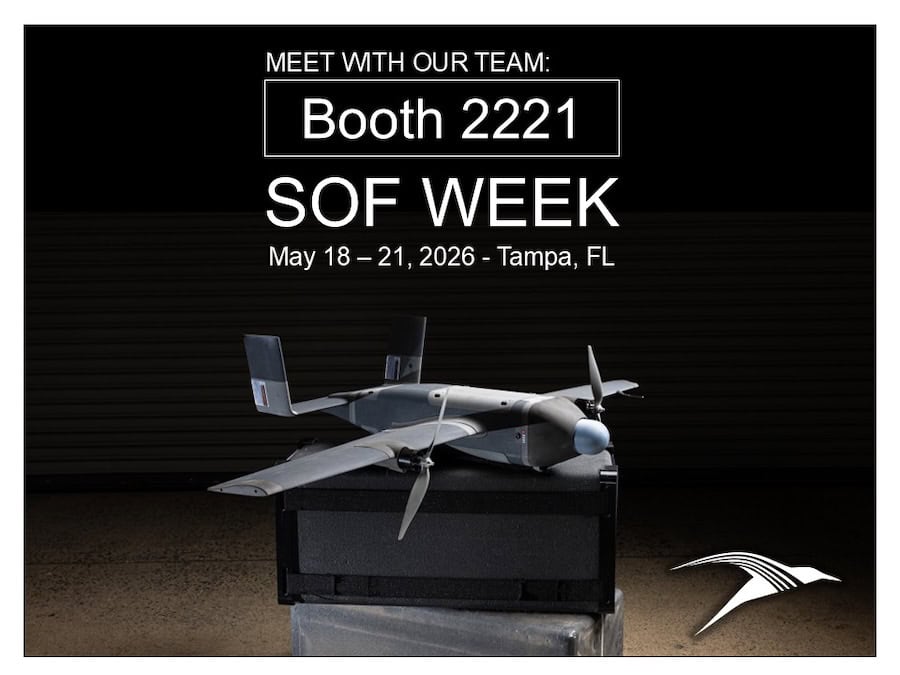
The vehicle’s modular architecture includes interchangeable nose sections, payload bays, wingtips, GNSS and visual navigation modules, telemetry tails, and multiple battery configurations, enabling rapid infield reconfiguration with minimal tools. Deployment options support operations at every scale, including hand launch for rapid, low-footprint missions, a 4-pack rail launcher for multi-sortie operations, and BlitzBox, an ISO container launcher capable of deploying dozens of aircraft for synchronized mass effects. These configurations allow operators to shift between ISR, EW support, deception, and multi-aircraft swarm effects without changing aircraft families or ground systems.
The intuitive design and ATAK compatibility reduce training requirements for unfamiliar operators to under two hours, supporting rapid integration into small units and distributed formations as global conflict dynamics emphasize attritability, autonomy, and flexibility. The system is currently available for demonstrations and procurement to eligible U.S. and allied customers.