


Discover World-Leading Unmanned and Autonomous Technologies
Discover cutting-edge solutions from leading global suppliers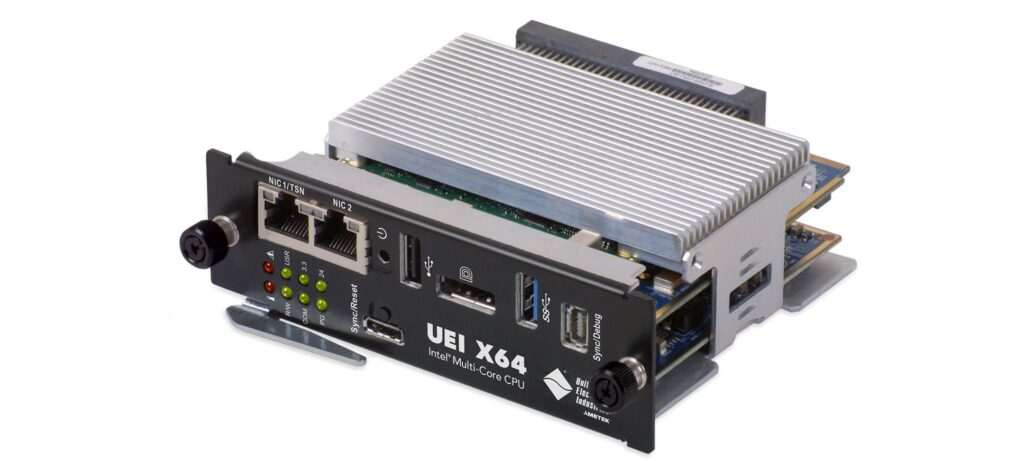
United Electronic Industries has integrated the Intel x6425RE quad-core processor into its family of programmable automation controllers to provide enhanced performance and reliability for mission-critical applications.
The upgrade to the UEIPAC line is designed to meet the demands of the aerospace, defense, transportation, and automated testing sectors. The x6425RE processor utilizes a 64-bit architecture running at 1.9 GHz while maintaining a low 20 W power draw. This hardware configuration includes 8 GB of RAM and 32 GB of eMMC storage, with additional expansion available via an M.2 slot supporting NVMe SSDs of 320 GB or more for data-heavy workloads.
Operating system flexibility is a core feature of the new integration, with support for Windows 11 IoT Enterprise and Rocky Linux 9.2. This allows engineers to run LabVIEW applications directly on the controller, a shift that eliminates the need for external PCs and significantly reduces latency. By enabling real-time control and monitoring within a familiar Windows embedded environment, the platform improves overall system mobility and operational efficiency.
Connectivity and timing precision are managed through dual Gigabit Ethernet ports that support IEEE-1588 and time-sensitive networking standards. These features ensure low-latency communication across the system’s hardware, which is compatible with over 90 I/O and avionics boards. To protect sensitive data, the controllers include TPM 2.0 for hardware-based security.
Alex Ivchenko, Director of Engineering, said, “Precision timing, deterministic performance, and secure control are essential in today’s embedded systems. With the Intel x6425RE processor, our customers gain a future-proof platform built for modern automation.”
The system is engineered for extreme environments, rated for operation in temperatures ranging from -40 to 85° C. To support long-term industrial and defense lifecycles, the platform is backed by a 10-year availability guarantee. Developers can utilize a wide range of programming languages for tailored solutions, including C/C++, Python, MATLAB, and Simulink. These capabilities make the platform suitable for hardware-in-the-loop testing, ground vehicle control, and avionics verification.