Discover World-Leading Unmanned and Autonomous Technologies
Discover cutting-edge solutions from leading global suppliers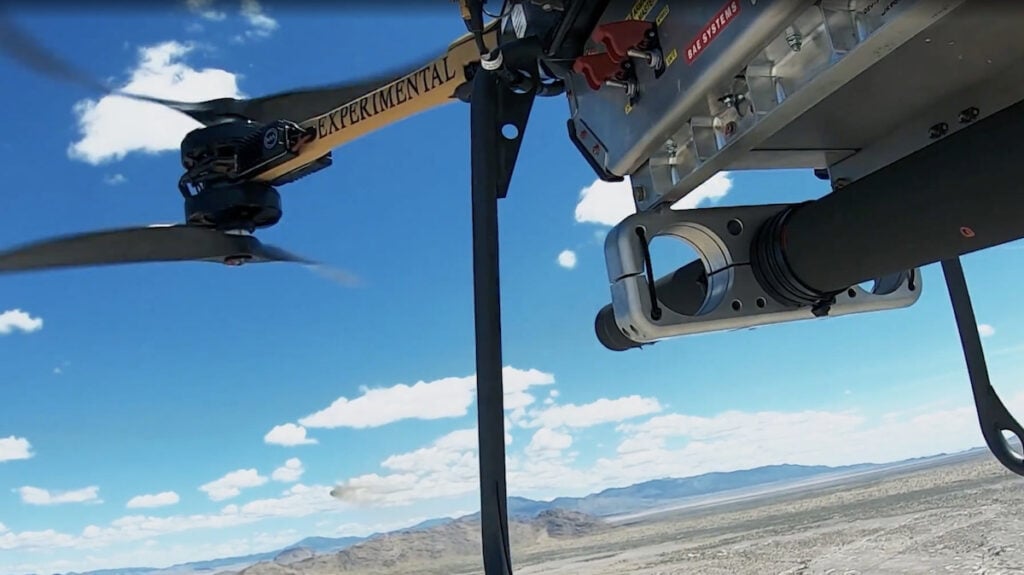
BAE Systems has successfully launched a precision munition from a multi-rotor uncrewed air system (UAS), destroying both air and ground targets during trials in the US.
This marks a major step forward in the development of a low-cost strike and counter UAS option for frontline troops.
The launch of munitions upgraded with BAE Systems’ APKWS® laser-guidance kit from a TRV-150, a modified version of the Malloy T-150, marks the first air-to-air engagement of an APKWS guidance kit from a UAS. This builds on its decades-long presence on combat aircraft, including the F-16, F-18, and Apache helicopter.
The successful trials demonstrate the multi-role capability of the platform and are a significant boost to showcasing how advancements in drone technologies can be harnessed to offer militaries highly effective and affordable tactical options to tackle both emerging UAS threats and more traditional targets.
The tests took place at the US Army Dugway Proving Ground in Utah. A modified version of BAE Systems’ Malloy T-150 was used, adapted to meet the US Marine Corps logistics requirements, known as the SURVICE TRV-150.
BAE Systems engineers in the UK provided expert weapons integration knowledge and experience to integrate the APKWS guidance kit. It transforms unguided rockets into precision-guided munitions and provides a low-cost, highly effective solution that has multi-role capabilities. The integration onto the TRV-150 exceeded expectations in all aspects, including platform performance and target engagements. The trials were particularly successful, with zero misses.
Anthony Gregory, Business Development Director, BAE Systems’ FalconWorks, commented, “Uncrewed systems are an increasingly important part of our customers’ arsenals and I’m delighted that we’ve been able to show how UAS technology can further help them maintain an edge on the ever-evolving modern battlefield. These trials have significantly advanced our ability to deliver this new tactical option at a fraction of the cost of conventional means, showcasing that we continue to address the challenges of tomorrow through innovation and collaboration.”
Greg Thompson, President, SURVICE Engineering, also stated, “While originally designed as a tactical edge logistics drone, adding strike packages to different variants of the TRV is a natural extension that leverages an already-fielded UAS as a multi-role offensive and defensive asset. Providing medium UAS-delivered air and ground target strike capability will be a force-multiplying game changer and we are excited to play a role in bringing this new capability to our US and allied-nation warfighters.”
The successful integration on display during the trials highlights the possibility of providing operators with a unique solution for engaging targets at greater range than ground-launched solutions, using a system that can easily be deployed to the front line.
The trial was a result of efficient collaboration between BAE Systems FalconWorks®, BAE Systems, Inc., and SURVICE Engineering, bringing together knowledge and expertise from across the UK and US teams. The trials were also supported by Invariant Corporation, Arnold Defense, General Dynamics UK and L3Harris.
The team behind this cross-Atlantic partnership will now build on these successful trials to further refine the new system so that it is ready for use on the battlefield. This includes integrating more autonomous technology.