
Discover World-Leading Unmanned and Autonomous Technologies
Discover cutting-edge solutions from leading global suppliers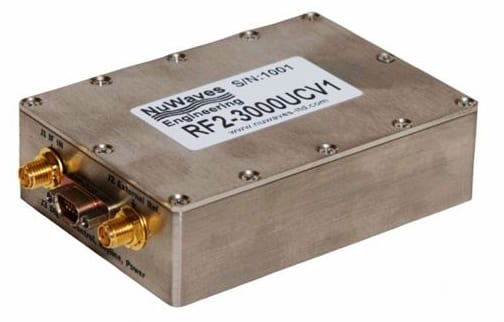
Multi-Octave RF Upconverter
NuWaves Engineering, an international Radio Frequency (RF) and Embedded Systems solutions provider, announced today that two of its module-level RF products, the Multi-Octave RF Upconverter (MORF™) and the ConvertaWave2™ Downconverter, have been selected by ViaSat Inc. to be embedded in the company’s VRG-1000 RF Signal Environment Generator product line.

ConvertaWave2 Downconverter
NuWaves’ MORF accepts a range of intermediate frequency (IF) signals and delivers a user-selectable RF output between 2 MHz and 3000 MHz for RF transmission. On the RF receiver side, NuWaves’ ConvertaWave2 accepts an RF signal from 200 MHz to 2500 MHz and delivers a bandwidth-filtered IF of 70 MHz, ready for baseband processing. Both modules are compact, offer highly precise tuning resolution, and provide superior out-of-band interference rejection.
“NuWaves’ MORF upconverter and ConvertaWave2 downconverter products make for a powerful tandem for use in high-performance RF communication, telemetry, and test systems,” said Jeff Wells, President and CEO of NuWaves Engineering. “We are very proud that ViaSat selected these commercial-off-the-shelf products to serve as key RF subsystems in their RF signal environment generator products.”